+91-124-4807600
 contact@supershine.in
Softmount vs Hardmount Washer Extractors: What Every Facility Manager Must Know

So here's a question we get asked a lot, usually right after someone has spent two hours staring at spec sheets and feeling more confused than when they started: "Should we go with a softmount or a hardmount washer extractor?"
And honestly, we get why it's confusing. Both machines wash clothes. Both spin water out. Both look like big metal drums with doors on them. So what's the big deal?
Turns out, quite a lot. The choice between softmount and hard mount affects everything from your floor's foundation to your electricity bill to how often your maintenance guy ends up under the machine with a wrench. Let's break it down properly, no jargon overload, just a real conversation about what actually matters.
The basic difference (in plain English)
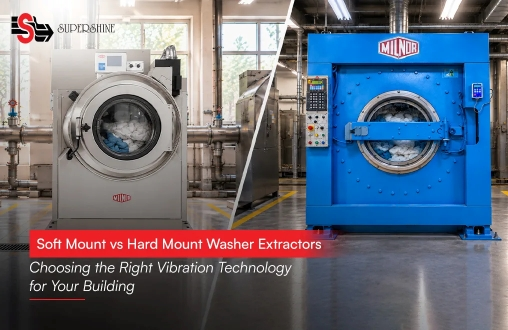
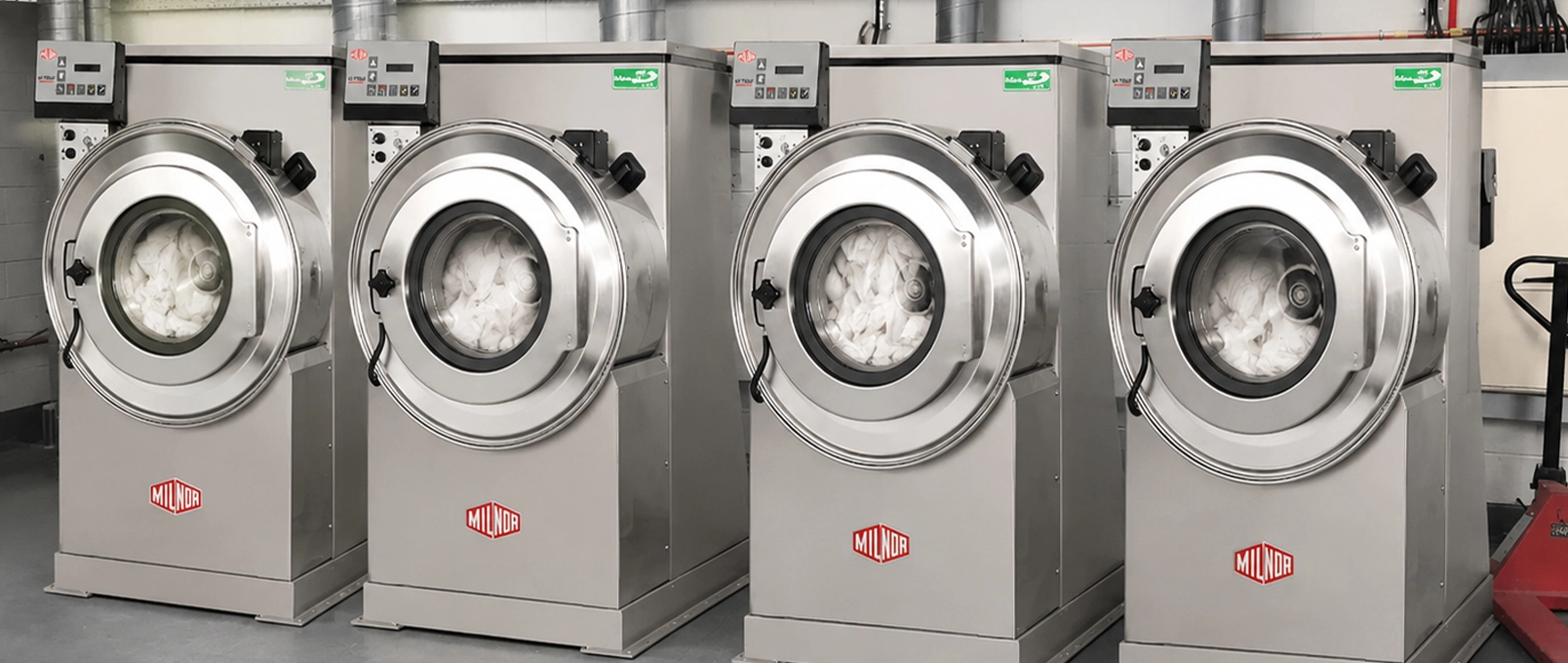
A hardmount washer extractor is bolted directly to the floor. It's rigid, sturdy, and doesn't move much during the wash or spin cycle. Because of this, it usually has lower extraction speeds, since high speeds would shake the machine and possibly the building.
A softmount washer extractor, on the other hand, sits on a suspension system, springs, dampers, and sometimes airbags that absorb vibration. This lets it spin much faster during extraction without transferring all that motion to the floor. Higher spin speed means more water gets removed before drying, which, honestly, is where the real savings happen.
If you want to see this in action, take a look at something like the 27 kg Mid-Range Suspended Washer-Extractor from Milnor. It's a soft mount machine designed to extract more moisture so your dryers don't have to work as hard. Compare that to something like the 18 kg Washer-Extractor with Programmable Control, which is hardmount and built for steady, reliable performance without needing a reinforced floor.
Why extraction speed actually matters
Here's the thing nobody tells you upfront. Drying is expensive. Like, genuinely one of the costliest parts of running a commercial laundry machine setup. Every extra percentage of moisture removed during the wash cycle is moisture your dryer doesn't have to burn energy to remove later.
Softmount machines typically extract at G-forces of 300 to 400+, while hardmount machines usually sit around 100 to 200 G. That difference adds up fast when you're running multiple loads a day. If you're running an industrial laundry washing machine setup that processes hundreds of kilos daily, that extraction difference can shave real money off your utility bills over a year.
But hardmount isn't "worse", it's just different
we want to be clear here because sometimes softmount gets hyped up like it's the obvious winner, and that's not really fair. Hardmount machines have their place, and honestly, a strong one.
For one, they're usually more affordable upfront. They don't need special foundation work (softmount machines, especially larger ones, often need a concrete pad or reinforced flooring to handle the dynamic loads, even with the suspension). If you're setting up in a rented space, or a building where you can't go drilling into the floor for anchors, a hardmount unit like the 36 kg Heavy-Duty Economy Washer might genuinely be the smarter, simpler choice.
They're also generally easier to relocate if your facility ever needs to be redesigned (and let's be honest, facilities always end up getting redesigned at some point, usually right after you've finally got everything arranged perfectly).
So which one do you actually need?
This is where it gets personal, because it really depends on your operation.
If you're running a high-volume laundry, think hotels, hospitals, or large-scale linen services, softmount machines like the 77 kg Suspended Washer-Extractors with Touch Screen Control or even something larger like the 125 kg High-Capacity Washer-Extractors with Color Touch Screen make a lot of sense. The energy savings on drying alone often justify the higher upfront cost within a couple of years.
If you're a smaller operation, maybe a boutique laundry, a gym, or a small clinic, a hardmount machine such as the 27 kg Reliable Economy Washer might be more than enough. You're not running it 16 hours a day, so the marginal efficiency gains from softmount won't matter as much.
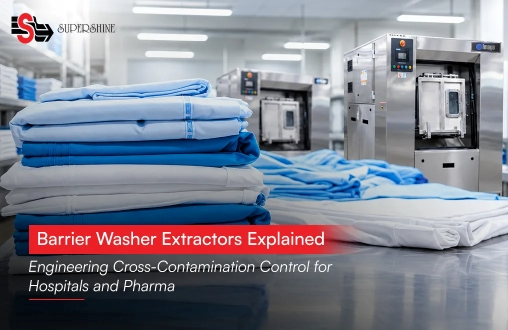
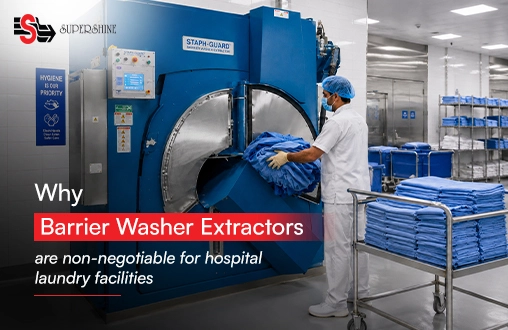
If hygiene is a top priority (and these days, when isn't it?), you might want to look at barrier washer extractors instead, which physically separate the clean and dirty sides of the laundry process. Options like the 45 kg Standard-Capacity Barrier Washer or the larger STAPH-GUARD® Washer-Extractor are built specifically for healthcare and other infection-sensitive environments. These are available in both softmount and hardmount versions, depending on your facility's setup.
A quick word on floor space and installation
One thing people often forget: softmount machines, despite being more efficient, sometimes have a smaller physical footprint relative to their capacity because the suspension system allows for a more compact frame design. So don't assume hardmount is always the space-saver; it really depends on the specific model.
Also, installation timelines differ. Hardmount machines can usually be up and running faster since there's less prep work involved. Softmount installations might take a bit longer if floor reinforcement is needed, so plan accordingly if you're working against a deadline (and aren't we always).
The honest bottom line
If we had to sum it up over that proverbial cup of coffee, softmount is about long-term efficiency and higher throughput, hardmount is about simplicity, lower upfront cost, and flexibility. Neither one is the "correct" answer for everyone, and honestly, a lot of larger facilities end up running a mix of both, hardmount for smaller, occasional loads, and softmount for the heavy daily grind.
What matters most is matching the machine to your actual workload, not just picking whatever sounds more "advanced". A perfectly sized hardmount unit will outperform an oversized, underused softmount one any day of the week.
If you're still on the fence, it might help to map out your daily laundry volume first, then work backward to figure out which extraction speed and capacity actually make sense. And if you're not sure how to do that math, well, that's a conversation for another blog (or honestly, just reach out to someone at Supershine who deals with this every single day).
Either way, now you know the real difference, and that's already half the battle.