+91-124-4807600
 contact@supershine.in
Barrier Washer Extractors Explained: Engineering Cross-Contamination Control for Hospitals and Pharma

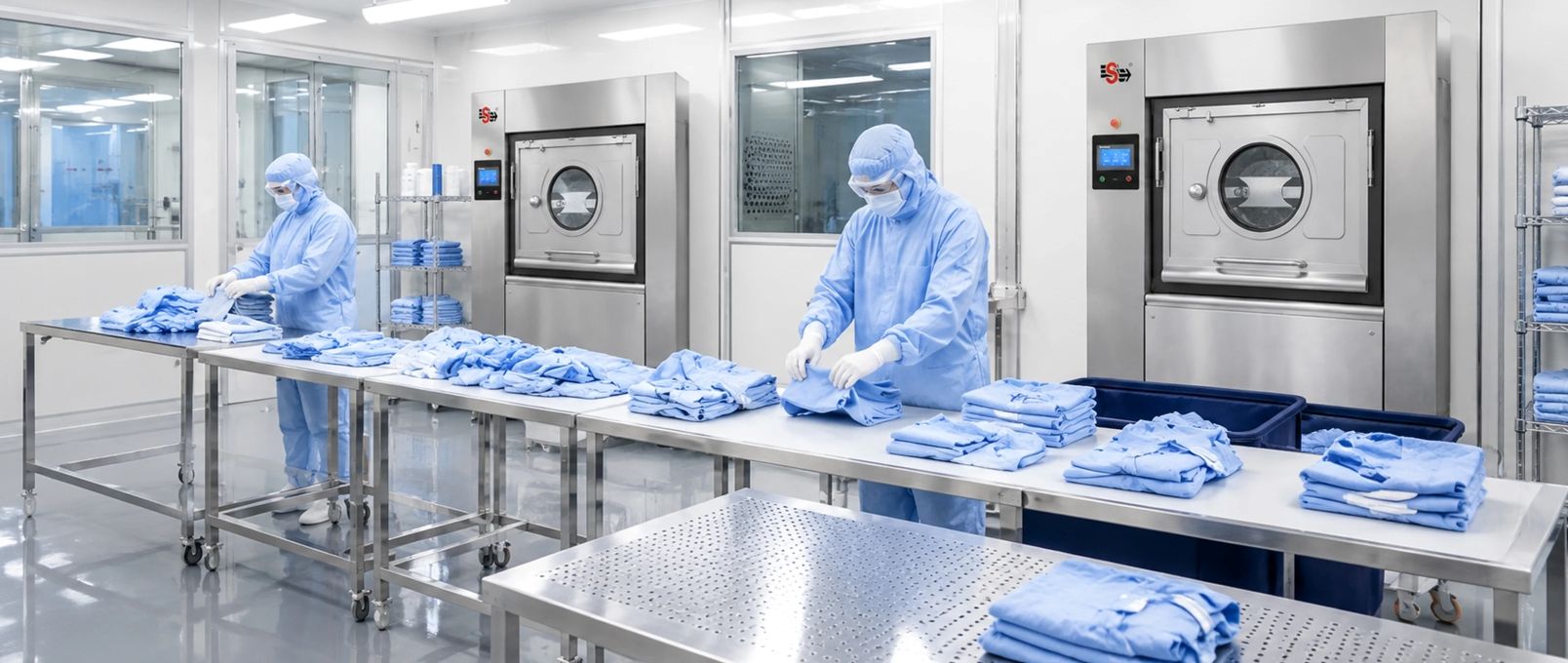
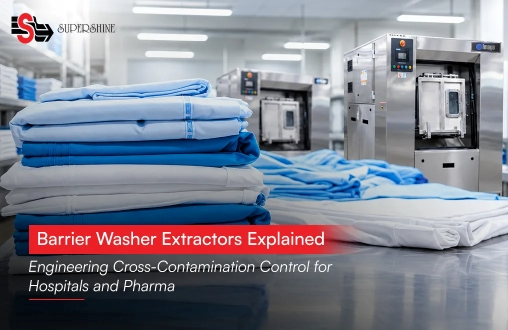
If you're evaluating laundry equipment for a hospital central sterile linen unit or a pharmaceutical cleanroom garment facility, you already know the stakes are different from a hotel back-of-house laundry. A soiled towel is an inconvenience. Soiled linen or a contaminated cleanroom coverall re-entering a controlled environment is a compliance failure, and potentially a patient safety or product safety incident. That's exactly the problem barrier washer extractors are engineered to solve. For hospital administrators building out infection-control infrastructure, this is where the barrier washer becomes the anchor of the entire hospital laundry system. None of this works in isolation from the rest of the plant. A facility investing in barrier technology still needs a properly specified hospital washing machine fleet for general linen, validated pharmaceutical grade laundry solutions for cleanroom garment work, and a supplier who understands commercial laundry equipment for hospital environments end to end. Getting the right commercial washing machine for hospital use, barrier and non-barrier alike, is what turns a single compliant machine into a fully compliant laundry operation.
This isn't a generic "hospitals need clean laundry" piece. It's about the actual engineering that separates a barrier washer from a standard industrial washer extractor, and why that distinction matters so much once you're dealing with infection control officers, pharma QA teams, or an accreditation audit. Supershine has specified and installed barrier laundry systems for exactly this kind of hygiene-critical environment, so the technical detail below reflects what actually gets asked at the planning table, not marketing copy.
What Makes a Washer Extractor a "Barrier" Machine
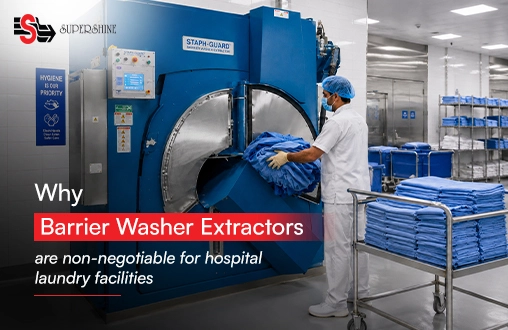
A barrier washer extractor is physically built into a wall. The machine has two doors on opposite sides of a single drum: one door opens into the soiled, contaminated side of the facility, and the other opens into the clean side. There's no way to open both doors at once, and there's no path for a soiled item, an airborne particle, or a member of staff to move directly from the dirty zone to the clean zone.
That last point is the entire purpose of the machine. Contamination control in healthcare and pharma laundry isn't primarily about the wash chemistry (though that matters too). It's about eliminating the physical and airborne pathways by which contamination crosses from unwashed to washed material.
The Physical Separation
- Dual-door, single-drum design: soiled linen loads from the contaminated side; the same drum, after a full wash and thermal or chemical disinfection cycle, discharges clean linen only into the clean side.
- Interlocking mechanism: an electromechanical or software interlock ensures the soiled-side door cannot open while the clean-side door is open, and vice versa. This isn't optional convenience, it's the core safety feature.
- Wall-mounted installation: the machine forms part of the architectural barrier between the two zones, not just a piece of equipment sitting in a room. This means facility planning has to treat the barrier washer as a structural element from day one, not an afterthought fitted into an existing layout.
The Airflow Question Most People Miss
Physical separation alone doesn't stop airborne contamination. That's why properly designed barrier laundries also manage air pressure differential between the soiled and clean sides. The soiled area is kept under negative pressure relative to the clean area (or the clean area under positive pressure, depending on your HVAC design philosophy), so air always moves from clean to dirty, never the reverse, whenever a door is briefly opened. In pharma cleanroom applications, the clean side is frequently HEPA-filtered and maintained to a defined ISO 14644 cleanliness classification, since the garments coming out feed directly back into a controlled manufacturing environment.
Hospitals: Thermal Disinfection and Workflow Segregation
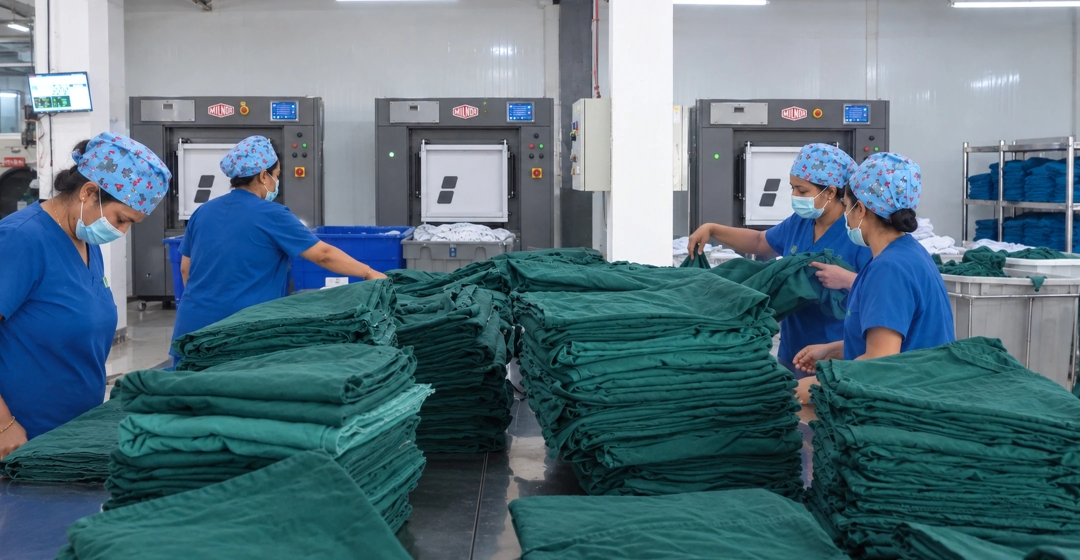
For hospital linen, the disinfection step inside the barrier washer typically follows a validated thermal or chemo-thermal process, commonly a sustained wash temperature of around 71°C for a minimum hold time, or a lower temperature combined with a validated disinfectant where thermal disinfection isn't practical for certain fabrics. This is the same principle behind RABC (Risk Analysis and Biocontamination Control), the EN 14065 framework many hospital laundries and their equipment specifications are built around.
But the machine only delivers half the outcome. The other half is staffing discipline:
- Dedicated staff per zone. Soiled-side staff don't cross to the clean side mid-shift without a full change of PPE and, ideally, a hygiene changeover procedure.
- One-way material flow. Linen only ever moves from soiled to clean, never back, and trolleys used on the soiled side stay on the soiled side.
- Documented cycle verification. Wash temperature, time, and chemical dosing get logged per cycle, not spot-checked occasionally, because that log is what an infection-control audit or accreditation review will ask for.
- Segregated transport. Clean linen leaves through a route that never intersects the soiled collection route, right up to the ward or department it's delivered to.
A hospital that installs a barrier washer but doesn't rebuild the surrounding workflow around it has spent money on a machine without buying the actual outcome. This is where a lot of facility teams underestimate the project. The hygienically clean linen result depends on the machine, the building layout, the HVAC design, and the staff SOP all working together.
Pharma: A Different, More Exacting Standard
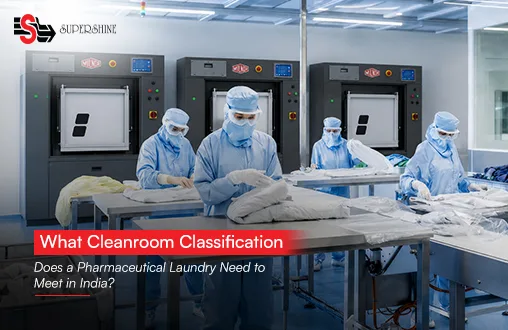
Pharmaceutical and biotech manufacturing facilities push the same barrier concept further. Cleanroom garments (coveralls, hoods, gloves in some processes) that have picked up particulate or microbial bioburden in a Grade C or Grade D manufacturing area need laundering that doesn't just clean them; it needs to bring particle counts and bioburden down to levels validated for re-entry into the controlled environment. This is where pharmaceutical grade laundry solutions become essential, combining controlled processing, validated cleaning protocols, and rigorous quality documentation.
That validation is not casual. Pharma QA teams typically require:
- Documented, repeatable wash cycle parameters validated against particle count and microbial recovery testing, not just “looks clean.”
- Segregated, classified clean-side unloading that matches or exceeds the cleanliness grade the garment is returning to.
- Traceability of which garments went through which cycle, tied to batch and lot records where the facility's quality system requires it.
- Change control on the laundry process itself, since an unapproved change to wash chemistry or cycle time can invalidate the garment's qualification for reuse.
This is a meaningfully more exacting standard than hospital linen processing, and it's why treating pharma garment laundering as "hospital laundry with extra steps" undersells the engineering and documentation actually required for pharmaceutical-grade garment care.
What to Actually Specify
When you're evaluating barrier washer extractors for a hospital or pharma project, the machine spec sheet is only part of the decision. Confirm:
- Drum capacity matched to actual daily soiled linen or garment volume, not a rough estimate.
- Programmable, lockable cycle parameters so staff can't override validated wash programs.
- Interlock reliability and a documented failure mode (what happens if the interlock fails, and does it fail safe).
- Compatibility with your facility's disinfectant or detergent chemistry, especially for pharma applications with specific approved chemical lists.
- Serviceability from the soiled side, since a technician shouldn't need to enter the clean zone for routine maintenance.
Supershine Laundry works with hospital infection-control teams and pharma facility engineers on exactly this kind of specification, because a barrier washer that's wrong for the building's actual workflow creates more risk than it removes. Getting the drum capacity, interlock design, and disinfection cycle validated against your facility's real volumes and standards, before the equipment is ordered, is what actually delivers the cross-contamination control the machine is supposed to provide. Supershine's role here is as much about the surrounding engineering conversation as it is about the machine itself.