+91-124-4807600
 sales@supershinelaundry.ae
Finishing Press vs Steam Tunnel: Which Garment Finishing Line Fits Your Indian Factory

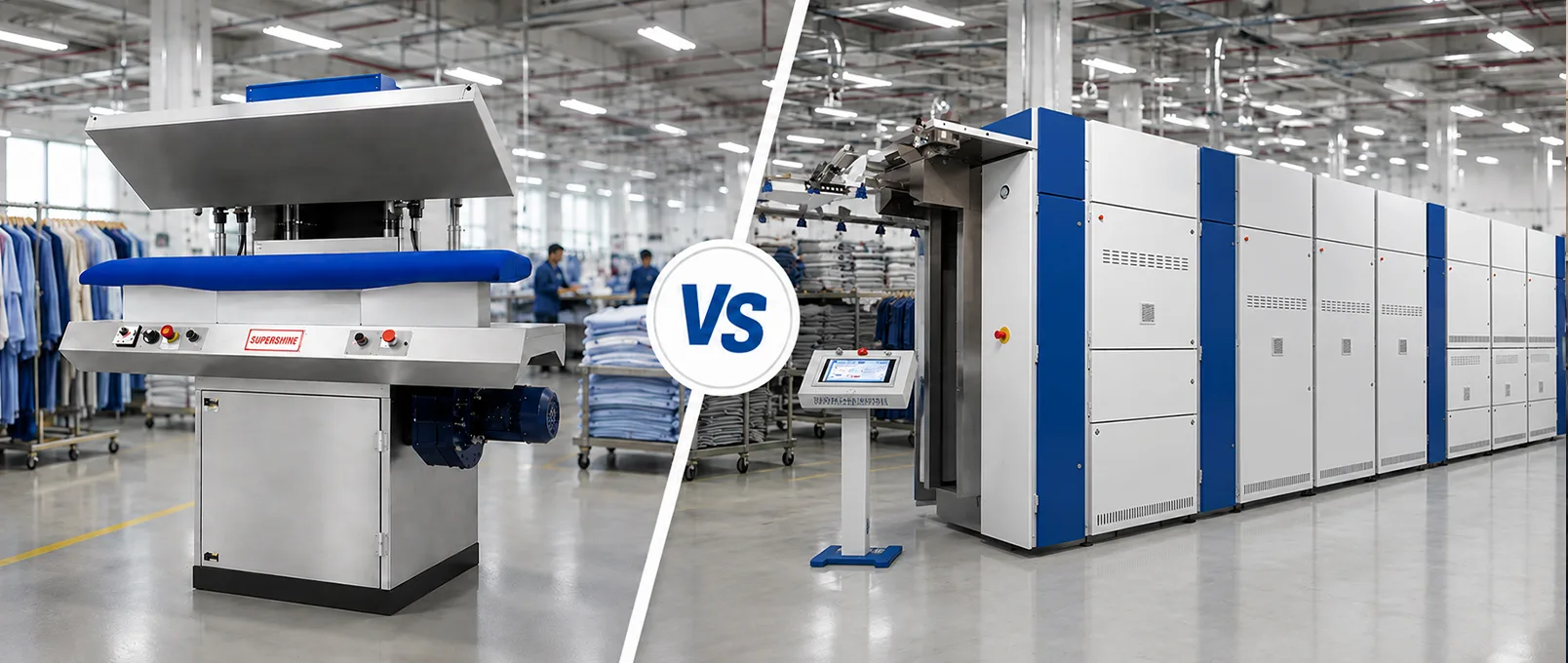
Walk into two garment finishing floors in India and you might see completely different setups doing, on paper, the same job: getting wrinkles out of finished garments before they ship. One uses a commercial laundry press machine working piece by piece. The other runs garments through a continuous steam tunnel at volume. Which one is actually right for your factory? It genuinely depends on what you’re producing, and how much of it.
What a Finishing Press Actually Does
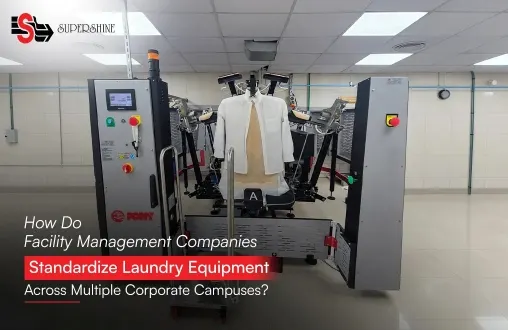
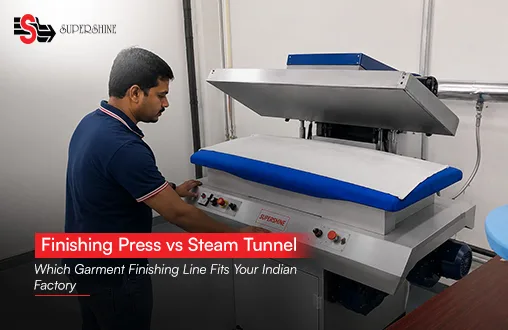
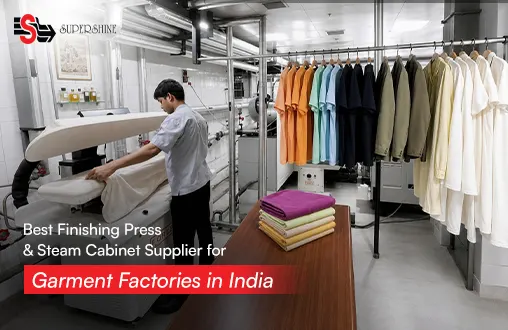
A finishing press, sometimes called a form press or dolly press, uses a canvas-covered form shaped roughly like the garment, combined with steam and compressed air, to press the entire garment at once rather than section by section. It’s called a “finisher” rather than a “presser” for a reason: it applies relatively low pressure and mainly removes accidental creases rather than setting new ones into the fabric. This matters for certain fabric types where you want a clean, wrinkle-free finish without a sharp crease line. The tradeoff is throughput. A press handles one or two garments at a time, making it inherently a batch process.
What a Steam Tunnel Finisher Does Differently
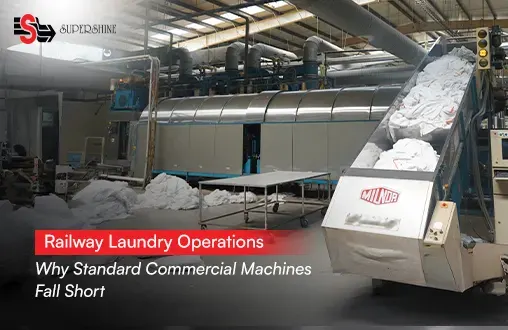
A steam tunnel finisher works on an entirely different principle: continuous flow instead of batch handling. Garments hang on a conveyor and move through a steam chamber first, which makes the fabric moldable, then through a strong hot air flow that removes wrinkles without any physical pressure or contact, and finally through a cool air stage that sets the fabric before it exits. No pressing, no contact, and critically, a single operator can process hundreds of garments through a tunnel in the time a press handles a handful. For high-volume, similar-style garment runs (uniforms, workwear, standardised hotel linen), this throughput difference is enormous.
The Real Decision Factors for an Indian Factory
So how do you actually choose? It comes down to three things: your garment volume, your style variation, and your budget for industrial laundry equipment. If your factory runs high volumes of relatively standardised garments (think uniforms, school wear, or basic workwear), a steam tunnel’s continuous processing capacity will almost certainly deliver better cost-per-garment economics over time, even though the upfront machine investment is typically higher. If you’re finishing a wider variety of garment shapes, delicate fabrics, or lower daily volumes where flexibility matters more than raw throughput, a finishing press gives you more control per garment and a lower entry cost.
There’s also a hybrid reality worth mentioning: plenty of mid-sized Indian garment units run both, a tunnel for bulk standard-style runs and presses for detail work or specialty orders that need individual attention. It’s not always an either-or decision.
Where This Fits Into Your Broader Line
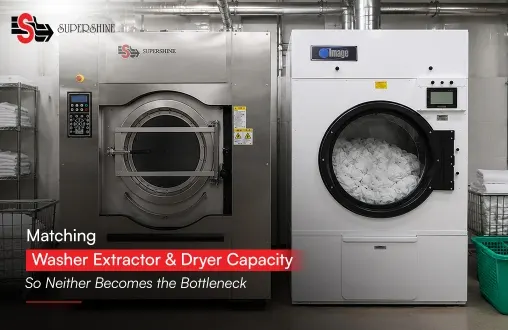
Neither machine works in isolation. Your finishing equipment sits downstream of your washing and drying process, so the moisture content coming out of your industrial washing machine and dryer stage directly affects how efficiently your finishing line performs, over-dried or under-dried garments both create more work at the finishing stage, regardless of which machine you’re using. This is one reason commercial laundry solutions need to be planned as a full line, not as isolated equipment purchases, because a mismatch between your wash-dry capacity and your finishing capacity creates a bottleneck somewhere, and that bottleneck costs you money daily.
Operator Skill and Training Requirements
Here’s something buyers rarely factor in until it’s too late: the two machines demand very different skill sets from your floor staff. A finishing press requires operators who understand garment shape and can position pieces correctly on the form for a clean result, which takes real training time and a bit of a learning curve for new hires. A steam tunnel, by contrast, is largely automated once garments are hung correctly, meaning the skill requirement shifts toward loading consistency and machine monitoring rather than individual garment handling. If your factory has high staff turnover, that difference alone might tip the decision toward a tunnel simply because it’s more forgiving of a less experienced workforce.
Maintenance and Running Costs Over Time
Steam tunnels, because they’re mechanically more complex (conveyor systems, multiple chambers, higher steam demand), tend to have higher maintenance costs and require a dedicated boiler or steam supply sized for continuous operation. Finishing presses are mechanically simpler and generally cheaper to maintain, though they still need regular attention to their canvas covers and steam valves. Factoring in maintenance budgets over a five-year horizon, not just the sticker price, often changes how the two options compare on paper.
Getting the Right Configuration for Your Factory
This is genuinely where experienced consultation earns its keep, because the “right” answer changes with every factory’s product mix. Supershine Laundry has spent 35 years advising garment manufacturing and textile processing units across India on exactly this kind of equipment decision, factoring in daily volume, garment type, existing wash-dry capacity, and floor space before recommending a press, a tunnel, or a combination of both. Supershine Laundry’s turnkey approach means the finishing line recommendation isn’t made in isolation either, it’s sized against your actual washer and dryer throughput so the whole line works together instead of creating a mid-process bottleneck.