+91-124-4807600
 contact@supershine.in
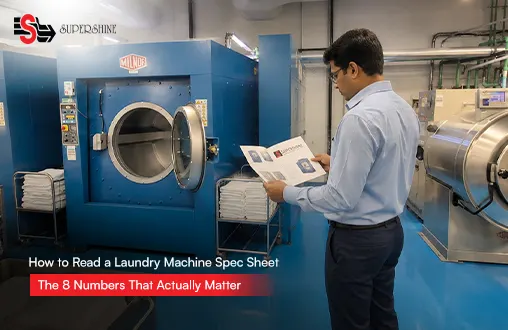
How to Read a Laundry Machine Spec Sheet: The 8 Numbers That Actually Matter


Every washer extractor quote comes with a spec sheet, and every spec sheet looks like it was written specifically to confuse you, rows of numbers, abbreviations, and units that don't obviously translate into "will this machine actually work for my facility." Here's the thing though, a laundry machine spec sheet from most laundry machine manufacturers isn't actually that complicated once you know which eight numbers matter and which ones are mostly noise.
Let's go through them properly.
1. Capacity, and Why the Unit Matters
Capacity gets listed in either pounds or kilograms of dry linen, and this is your starting point for everything else. A 60 lb washer extractor handles 60 pounds of dry laundry per load, roughly 27 kg. Industrial-strength washers typically start around 10 to 25 kg, mid-range units run 30 to 60 kg, and mega-load machines handle 80 to 160 kg, which is exactly the range where you'll find a typical railway commercial laundry machine, built to process uniforms and bedding at institutional scale. Match this to your actual daily volume divided by realistic cycle count, not your aspirational future volume, oversizing wastes water and detergent on partially filled loads just as much as undersizing creates a bottleneck.
2. G-Force, the Number Most Buyers Skip Past
This is genuinely one of the most important specs on the entire sheet, and it's the one people gloss over fastest. G-force measures the extraction power during the spin cycle, one G equals standard Earth gravity, two G means twice that force. Commercial washer extractor units typically range from 200 to 400 G during extraction. Higher G-force means less residual water left in the fabric after washing, which directly translates to shorter, cheaper drying cycles. A machine with weak extraction G-force will quietly cost you more in drying energy for the entire life of that machine, even if the upfront price looks attractive.
3. Cylinder Ratio and Wash Action
During the actual wash and rinse phase, the drum spins at just under 1G, gentle enough that laundry tumbles and falls freely inside the cylinder for proper mechanical cleaning action. This ratio between wash speed and extraction speed affects how thoroughly detergent and water work through the fabric, and it's worth asking your supplier to explain rather than assuming all machines handle this identically.
4. Motor Power and Horsepower
Most commercial-grade washers need a dedicated 240-volt line, with amperage typically in the 30 to 50 range, and a motor rating of at least 0.75 horsepower as a baseline for smaller units, scaling up considerably for larger capacity machines. This number matters for your electrical planning, not just machine performance, undersized electrical infrastructure for an oversized motor is a common and expensive surprise during installation.
5. Water Consumption Per Cycle
This one directly affects your ongoing operating cost and, in water-stressed regions, your practical ability to run the machine at full capacity throughout the day. Compare this figure across quotes at the same capacity level, the variance between machine models here can be significant, and it compounds daily across hundreds of cycles a month.
6. Heating Type and Capacity
Whether the machine heats via steam, gas, or electric changes both your infrastructure requirements and ongoing running costs substantially. This connects directly to decisions laundry machine manufacturers build into heating design, covered elsewhere, but on the spec sheet specifically, check the heating capacity rating matches what your boiler or gas supply can actually deliver, not just what the machine theoretically supports.
7. Cycle Time
Total cycle time, from load to unload, determines your daily throughput capacity more than almost any other single number. A machine with slightly lower capacity but meaningfully faster cycle time can out-process a larger, slower machine over a full working day. Always calculate throughput as capacity divided by cycle time, not capacity alone, when comparing two machines.
8. Physical Dimensions and Door Opening
The most overlooked spec, and the one that causes real installation headaches. Overall footprint, height clearance for maintenance access, and door opening size all need to match your actual room dimensions and doorway access, not just floor space. We've seen machines quoted and purchased that then couldn't physically get through the laundry room doorway, resulting in expensive rework that proper spec sheet review would have caught at the quotation stage.
Putting It All Together
None of these eight numbers matter in isolation, they interact. High G-force with slow cycle time still costs you throughput. Large capacity with weak extraction still costs you drying energy. The real skill in reading a spec sheet isn't memorizing what each number means, it's understanding how they combine to answer the only question that actually matters, will this machine deliver the daily throughput my facility needs at a running cost I can sustain.
Where Supershine Helps Cut Through This
At Supershine Laundry, whether it's a hotel, hospital, or a facility sourcing laundry machines for railway operations, this is genuinely the most common part of the sales conversation, walking clients through a spec sheet line by line, translating capacity and G-force and cycle time into what it actually means for their specific daily operation, rather than leaving them to decode a table of numbers alone. A spec sheet that looks impressive on paper doesn't always translate to the right machine for a particular facility's water quality, power supply, and room dimensions, and that translation is where a lot of buyers go wrong without proper guidance.
The Practical Takeaway
Next time a spec sheet lands on your desk, don't just look at capacity and price. Check G-force, cycle time, water consumption per cycle, and physical dimensions against your actual room and infrastructure. Those four numbers, alongside capacity, motor power, cylinder ratio, and heating type, are what actually determine whether a machine performs well in your specific facility or just looks good on a comparison spreadsheet.