+91-124-4807600
 contact@supershine.in
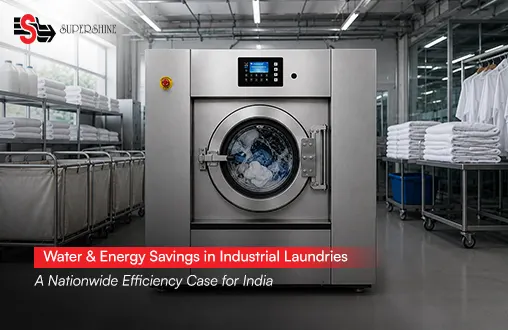
Water & Energy Savings in Industrial Laundries: A Nationwide Efficiency Case for India

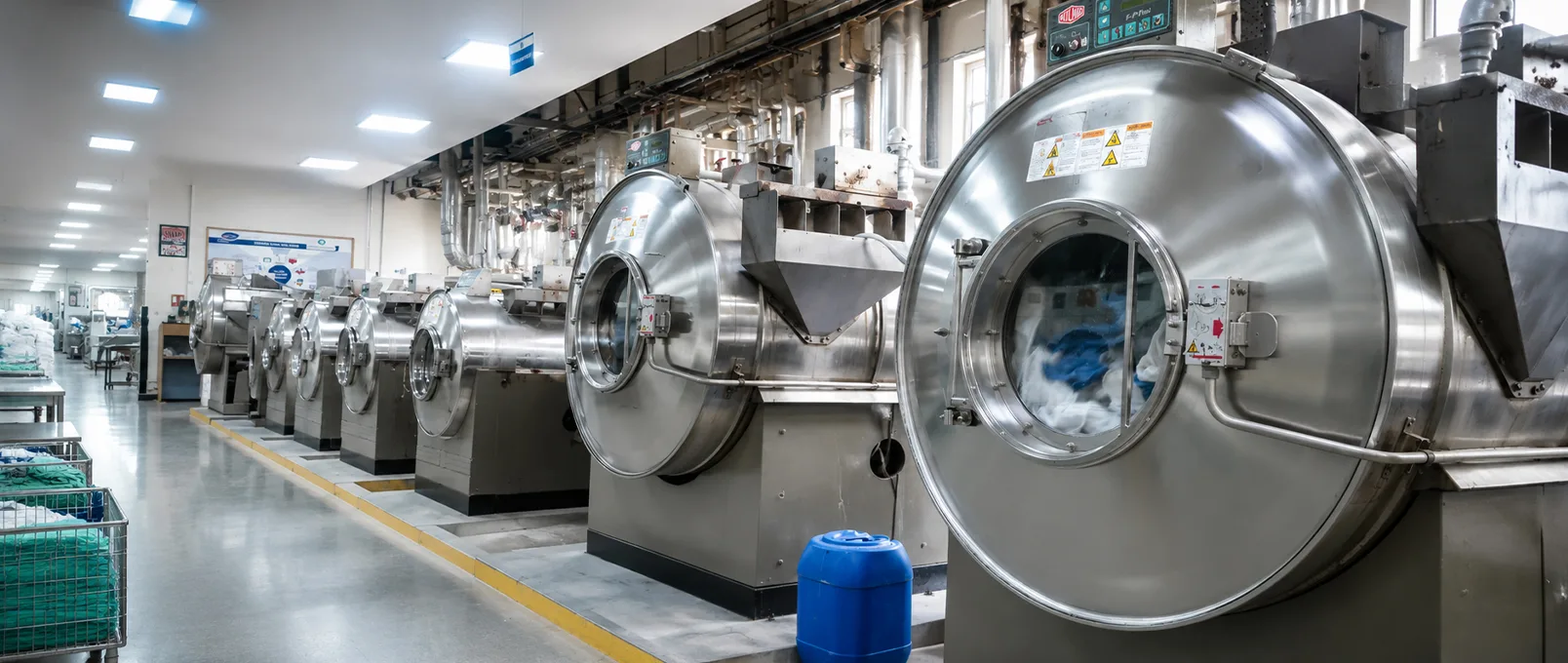
Ever wonder what happens to the thousands of bedsheets, towels, and uniforms that get washed every single day at a big hotel or hospital? Where does all that water go? And more importantly, where does it come from, given that large parts of India are already running short on it? These are not small questions anymore. They sit right at the center of how laundries in this country need to think about their operations going forward.
If you run a hotel chain, a hospital laundry, or a garment finishing unit, you already know that washing linen is not a small side task. It is a full operation with its own water bill, its own power bill, and its own headaches. So let us talk plainly about how a smarter machine, and a smarter setup, actually saves water and energy, and why this matters so much for India right now.
The Water Problem India Cannot Ignore
India's per capita water availability has been falling for years. It was around 1,545 cubic meters back in 2011 and is expected to drop closer to 1,341 cubic meters by 2025. Anything below 1,700 cubic meters per person is officially classified as water stress. We are well inside that zone. NITI Aayog's Composite Water Management Index has flagged that nearly 600 million people in India already face high to extreme water stress, and by 2030 water demand is projected to be roughly twice the available supply in many regions. That is not a distant problem. That is a next decade problem.
Laundries, especially large industrial ones, are heavy water users. A single old-style washing machine handling a bulk load can use anywhere from 15 to 25 liters of water per kilogram of linen if it is not designed well. Multiply that across a 500 room hotel or a 1000 bed hospital doing laundry every day, and you start to see why water efficiency is not just a nice to have. It is survival math.
So What Is a Washer Extractor and How Does It Work in Commercial Laundry?
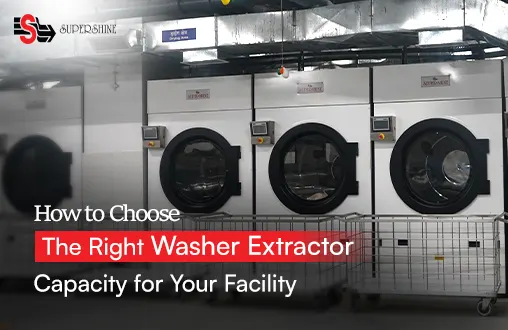
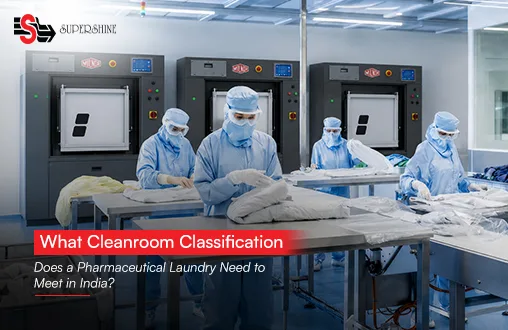
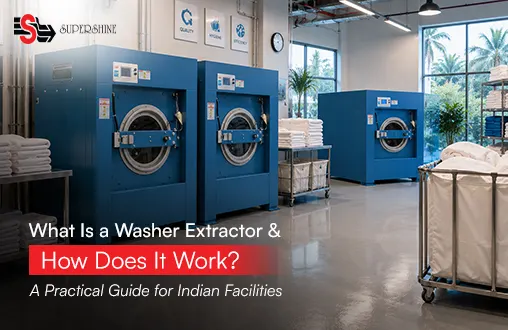
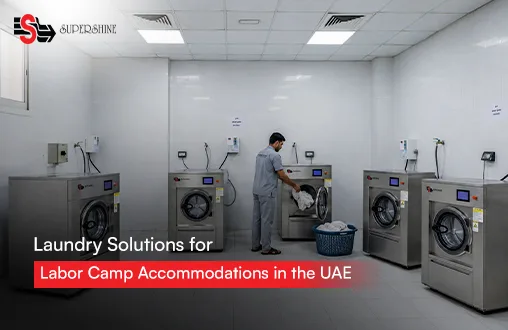
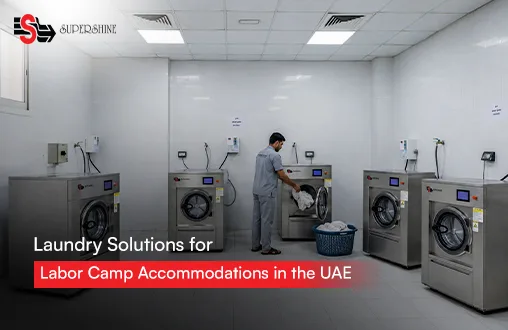
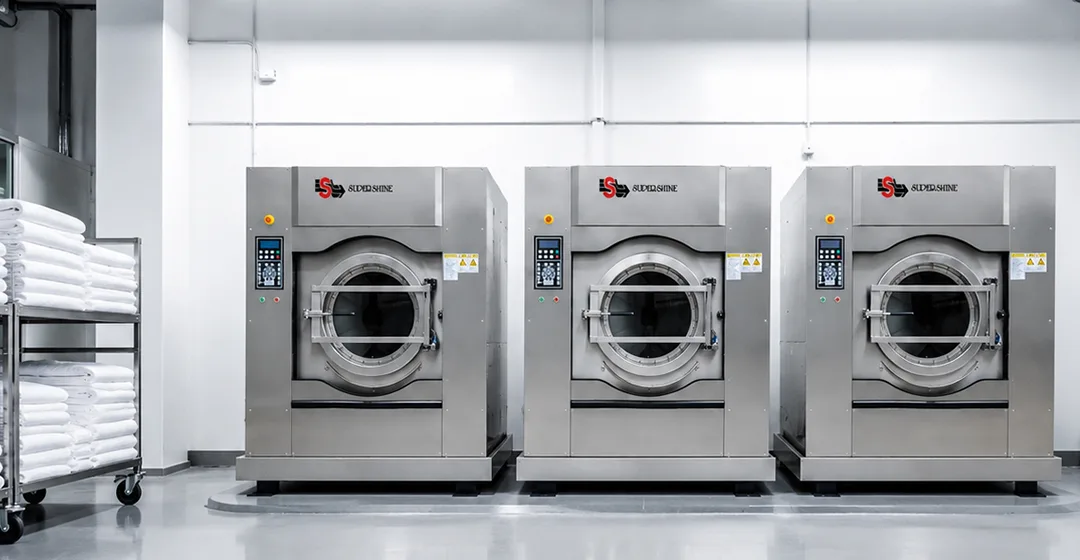
What is a washer extractor and how does it work in commercial laundry? This is probably the single most common question we get from clients who are new to industrial laundry setups, so let's break it down simply. A washer extractor is a machine that does two jobs in one drum. First it washes the linen, agitating it with water, detergent, and controlled heat to lift dirt, stains, and bacteria. Then, without moving the load to a separate machine, it spins at high speed to force water out of the fabric. That second part is called extraction, and it is where a lot of the real efficiency magic happens.
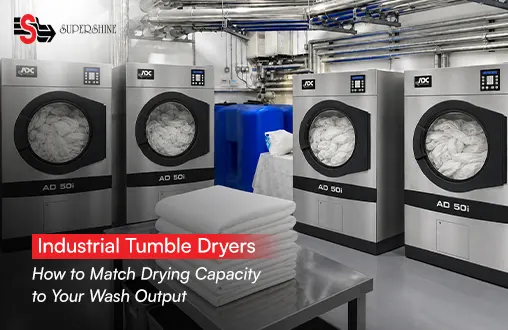
The spinning creates what is known as G-force, a measure of centrifugal force compared to normal gravity. Most commercial industrial washing machine units built for hotels and hospitals run in the 200 to 300 G range, which is enough to pull out excess water without stressing the fibers too much. Some heavy duty models used in industrial settings push toward 300 to 400 G for tougher fabrics like workwear or defense uniforms. The higher the G-force during extraction, the less water is left behind, sitting at somewhere around 45 to 55 percent residual moisture in well tuned machines. And here is the part that actually saves money. Less water left in the fabric means less work for the dryer afterward. A good industrial dryer machine paired with a properly extracting washer can cut drying time by 20 to 30 percent, which is a direct energy saving, not a theoretical one.
Water Reuse and Heat Recovery, the Quiet Heroes
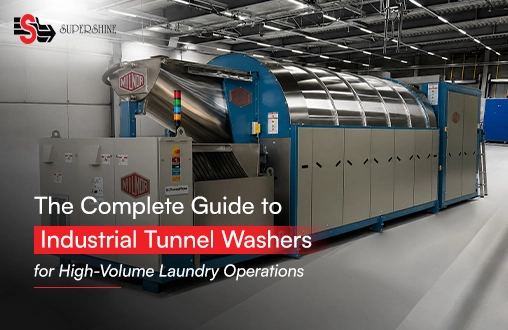
Beyond the spin cycle, the bigger savings usually come from what happens to water after it leaves the drum. Modern industrial washing machine and dryer systems, especially tunnel washers and higher end batch washers from brands like Milnor and Jensen, are built with water reuse loops. The final rinse water from one cycle, which is relatively clean, gets captured and reused as the first wash water for the next load. This alone can cut fresh water consumption by 30 to 50 percent in a well designed plant.
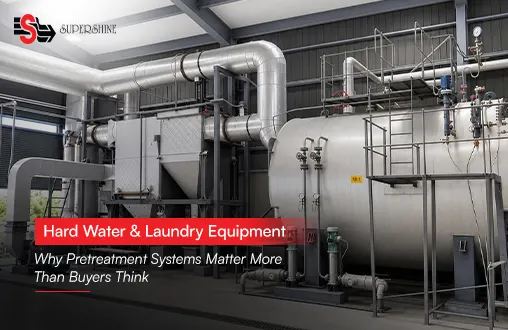
Heat recovery works on a similar principle but for energy instead of water. Hot wastewater leaving the machine passes through a heat exchanger, warming up the incoming fresh water before it even reaches the boiler or heater. Since heating water is one of the biggest energy costs in any laundry, recovering even half of that lost heat can meaningfully reduce gas or electricity use. Some plants report fuel savings of 20 to 35 percent once heat recovery is installed properly alongside insulated pipework and tanks.
Why Supershine Focuses on Efficiency, Not Just Machines
At Supershine, we have been setting up laundry projects across India and the Middle East since 1990, so we have seen this shift happen in real time. Thirty five years ago, the conversation with a hotel or hospital was purely about capacity, how many kilograms per hour can this machine handle. Today, almost every serious client asks about water and power consumption before they ask about throughput. That tells you something about where the industry is headed.
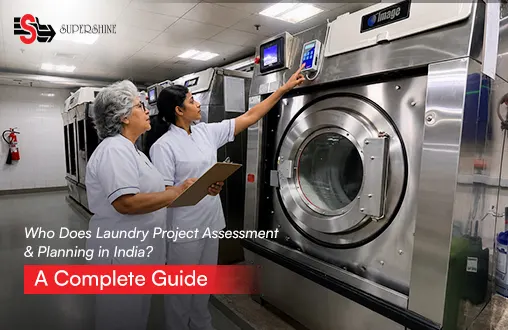
Supershine works with global names like Milnor, ADC, Jensen, Forenta, Italclean, and Image, partly because these brands have genuinely invested in energy efficient laundry machines rather than just repackaging older designs. When we assess a site, whether it is a defense establishment kitchen linen unit or a garment manufacturing plant, we look at water source, effluent treatment capacity, and power load before we even start recommending equipment. That is the turnkey part of what Supershine does, from the first site visit through installation, commissioning, staff training, and ongoing AMC support.
It also helps to compare notes with what competitors are doing globally. Girbau and Electrolux Professional, both strong European players, have pushed hard on water reuse technology in their higher end lines, and Milnor's tunnel systems are often cited as some of the most water frugal in the world for high volume operations. Jensen, similarly, has built entire finishing lines around minimizing both water and steam use. Supershine's role is to bring the right combination of these technologies into Indian conditions, where water quality, power stability, and local service support all matter as much as the spec sheet.
What This Means for Your Bottom Line
Let's be honest, most facility managers do not adopt efficient laundry equipment purely out of environmental concern. They do it because the numbers work. A 300 bed hospital replacing old top loading machines with a modern industrial washing machine and matched dryer setup can often see water bills drop by a third within the first year. Add heat recovery and the payback period on the entire upgrade, including the dryer, frequently falls under three years, sometimes faster depending on local utility rates.
There is also a compliance angle that is growing more important every year. Pollution control boards across Indian states are tightening effluent discharge norms, and hotels chasing green certifications need documented water savings. Having a laundry setup that genuinely reduces consumption, not just on paper but in daily operation, is becoming part of what makes a property competitive, not just compliant.
None of this requires exotic technology. It requires choosing the right washer extractor, pairing it with a dryer that matches its extraction performance, adding water reuse and heat recovery where the volume justifies it, and maintaining the system properly over years, not just at installation. That last part, ongoing maintenance, is where a lot of savings quietly disappear if nobody is watching. Worn seals, scaled heat exchangers, and drifting G-force calibration can silently push consumption back up within a couple of years if there is no AMC in place.
India's water stress is not going away. If anything, projections suggest it gets tighter before it gets better. Industrial laundries, precisely because they use so much water in concentrated volume, have an outsized opportunity to make a dent in that problem while also saving real money. Supershine Laundry has spent over three decades helping clients across hotels, hospitals, defense establishments, pharmaceutical companies, and educational institutions make that shift, one plant at a time.