+91-124-4807600
 contact@supershine.in
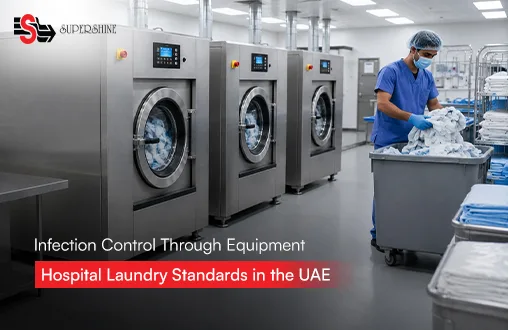
Infection Control Through Equipment: Hospital Laundry Standards in the UAE

Ever wondered what happens to hospital bedsheets after a patient with a serious infection is discharged? Where do those towels, gowns and surgical drapes actually go, and how does a hospital in Dubai or Abu Dhabi make sure the next patient isn't exposed to whatever was on them? It's not a glamorous question. But if you work in healthcare facilities management, procurement, or infection prevention, it's one of the most important questions you'll ever ask. And the honest answer is that the whole thing comes down to equipment. Not mops, not disinfectant sprays, but the actual machines doing the washing.
We talk to hospital administrators across the UAE fairly often, and the same worry keeps coming up. Linen looks clean. It smells clean. But does it meet the microbial standard a hospital actually needs? That gap between "looks fine" and "is actually disinfected" is where infection control lives or dies, and it's exactly why the equipment conversation matters so much more in a hospital than in a hotel down the road.
Why Hospital Laundry Is a Different Game Entirely
A five star hotel washes towels. A hospital washes fabric that has been in contact with blood, wound exudate, bodily fluids, and sometimes multi drug resistant organisms. That's a different risk category altogether. The World Health Organization and the CDC have both published guidance stating that hospital linen should be washed using a thermal disinfection cycle, generally at a temperature of at least 71 degrees Celsius for a minimum of 25 minutes, or an equivalent low temperature chemical disinfection cycle around 65 degrees Celsius for 10 minutes when combined with an approved disinfectant. Some accreditation bodies, including those aligned with JCI expectations that many UAE hospitals follow, push for slightly higher thresholds on heavily soiled or infectious linen, often above 71 degrees for at least 3 minutes as part of a validated cycle.
This is why a commercial washing machine for hospital use cannot just be a bigger version of what a hotel uses. It needs programmable thermal cycles, validated temperature holds, and often a chemical dosing system that can be tracked and audited. Regulators in Dubai and Abu Dhabi, through DHA and DOH respectively, expect healthcare facilities to demonstrate that their linen processing meets documented infection control protocols, not just a general cleanliness standard.
The Barrier Washer: The Single Biggest Equipment Decision
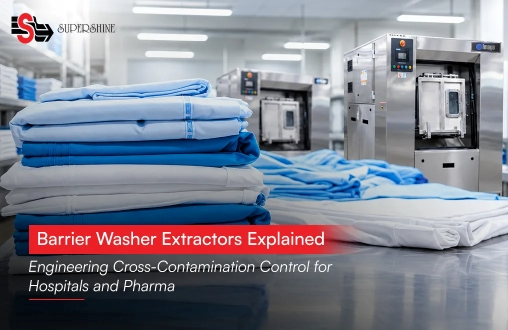
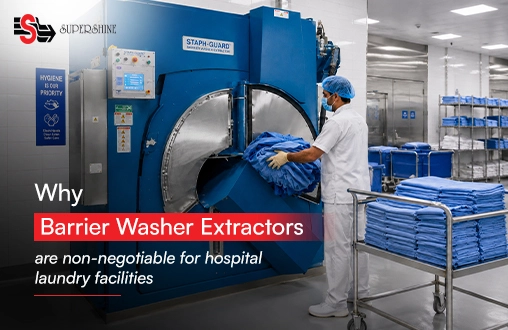
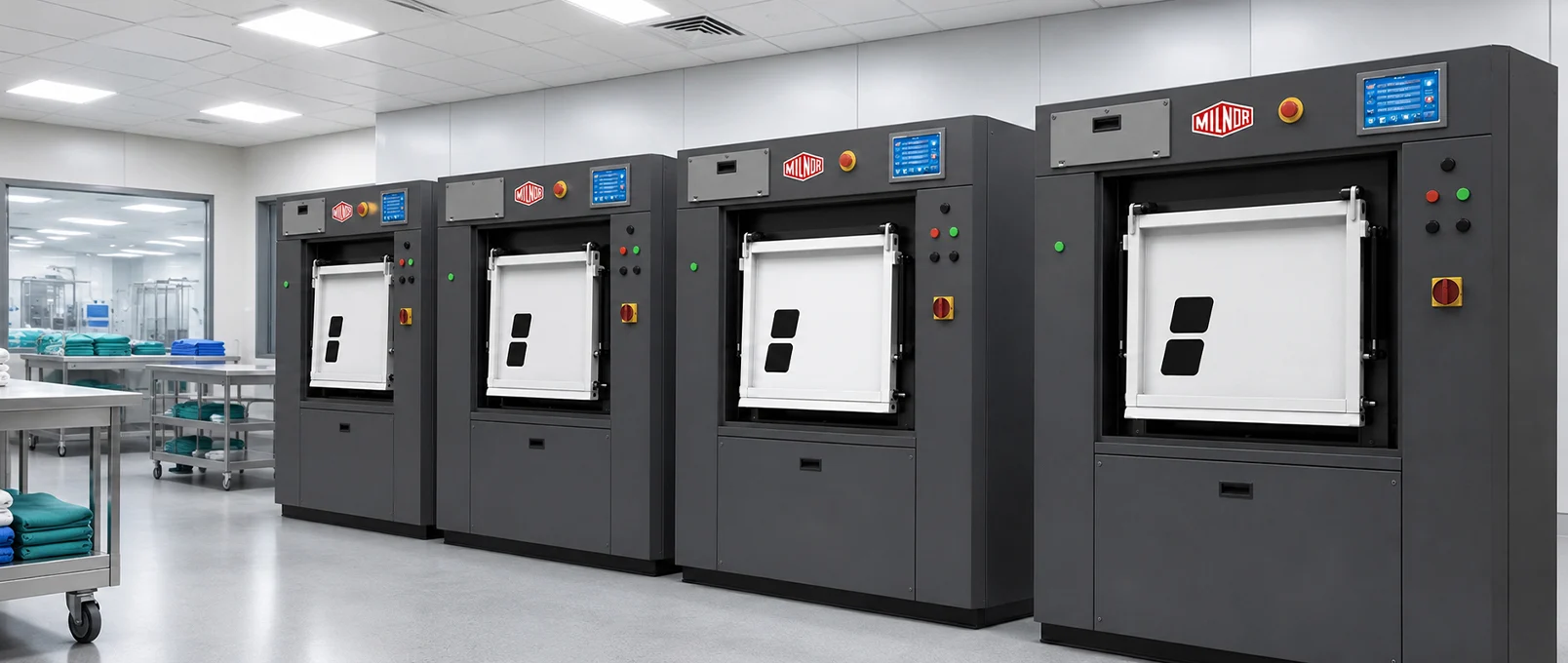
If there's one piece of equipment that defines a compliant hospital laundry setup, it's the barrier washer extractor. Picture a washing machine built straight into a wall, with one door opening into the soiled linen area and a second door opening into the clean linen area on the other side. Once a load goes in from the dirty side, it can only come out clean, on the other side of that wall. There is no way for a staff member to accidentally cross contaminate a batch because the physical layout simply doesn't allow it.
This "dirty in, clean out" design is considered the gold standard in hospital laundry systems worldwide, and it's becoming close to a baseline expectation in UAE tertiary care hospitals and larger private hospital groups. Brands like Girbau, Electrolux Professional, and Miele Professional all manufacture barrier washer extractor ranges specifically for healthcare, some going from smaller 18 kg units up to 250 kg plus machines for large centralised laundries. Jensen, known more for tunnel washing systems, plays in this space too for very high volume operations such as regional laundry hubs serving multiple hospitals.
Supershine works with several of these global manufacturers, which puts us in a slightly unusual position. We're not selling one brand and telling every hospital it's the right fit. We look at bed count, infection risk profile, available floor space and budget, then recommend whether a smaller barrier washer, a full tunnel system, or a hybrid setup makes sense. That flexibility matters a lot because a 60 bed specialty clinic in Sharjah has completely different laundry needs than a 500 bed multi speciality hospital in Dubai Healthcare City.
What Regulators Actually Look At
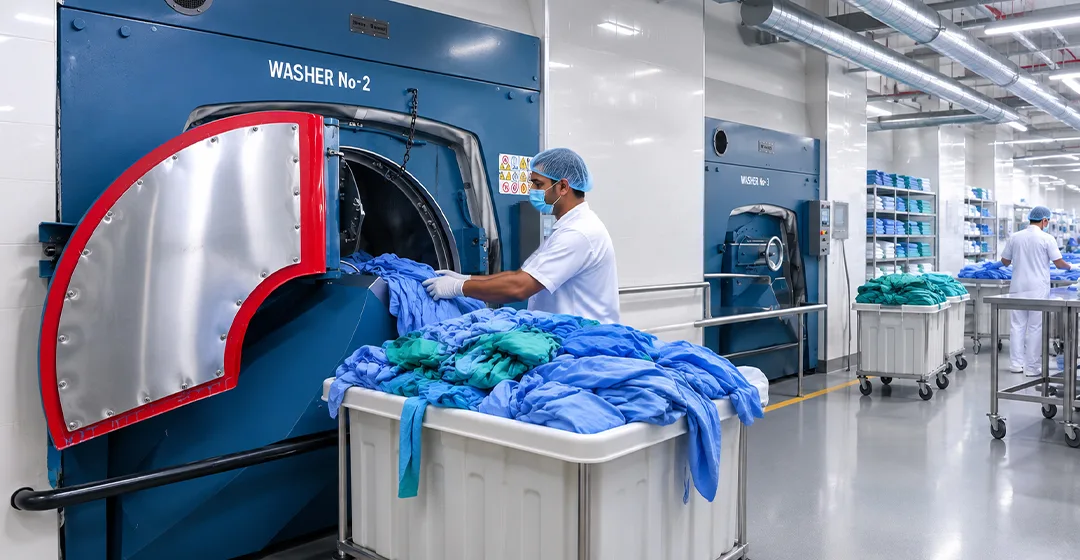
DHA and DOH inspections don't just check whether linen smells fresh. Auditors typically look at separation of clean and soiled workflows, documented wash temperatures and cycle times, staff PPE protocols in the soiled handling area, and whether infectious linen (from isolation wards, for instance) is bagged and processed separately from general linen. Operating theatre linen usually needs its own higher temperature cycle given the surgical site infection risk involved. This is a genuinely serious compliance area, not a box ticking exercise, and hospitals that fail an audit on linen handling can face real consequences during licensure renewal.
That's the practical reason so many facility managers start researching where to Buy washer extractor machine for hospital laundry in Dubai long before they open a new wing or renovate an old laundry room. Getting the equipment right the first time avoids a scramble later when an inspector flags a gap. It also, frankly, saves money, because retrofitting a barrier wall installation after a laundry is already built and running is far more expensive than planning it in from day one.
Beyond the Washer: The Full Equipment Chain
Washing is only step one. A proper hospital laundry machine setup also needs dryers rated for the volume and fabric type, ironing and finishing equipment for items like surgical gowns that need to look and feel a certain way, and increasingly, RFID or barcode tracking so linen can be traced batch by batch. Traceability matters more than people expect. If a patient develops a hospital acquired infection, being able to show exactly which wash cycle and batch processed their linen is part of a defensible infection control record.
Water and energy use is another real consideration, not just an environmental nice to have. Hospitals run laundry operations around the clock, and a poorly specified machine can waste enormous amounts of water and gas over its lifetime. Modern hospital washing machine units from brands like ADC and Italclean, both of which Supershine partners with, are built with heat recovery and water reuse systems that cut utility costs substantially compared to older models still running in some older UAE facilities.
Why the Turnkey Approach Matters
Here's something we've learned after 35 plus years doing this, going back to 1990: buying the machine is the easy part. The hard part is getting the layout right, training staff on the actual protocol (not just how to press buttons), and setting up a maintenance schedule that keeps thermal disinfection cycles accurate over years of heavy use. A barrier washer that isn't serviced properly can drift out of temperature calibration without anyone noticing until an audit catches it.
This is why Supershine handles the whole journey. We assess the facility, recommend the right mix of laundry machines for hospital use, handle installation and commissioning, train the laundry staff, and then keep the equipment running through an AMC contract. We've done this for hospitals, defense establishments, and pharmaceutical companies across India and the Middle East, and honestly, the AMC piece is where a lot of value gets created that people don't think about upfront. A machine that's serviced on schedule keeps its thermal disinfection accuracy for years. One that isn't can quietly become a compliance risk.
Choosing the Right Supplier
So how should a hospital in Dubai actually go about sourcing commercial laundry equipment for hospital departments? A few things genuinely matter. First, does the supplier offer more than one brand, or are they just pushing whatever they have in stock? Second, do they understand DHA and DOH expectations well enough to spec a system that will pass inspection, not just run? Third, is there a real local service and spare parts presence, because a barrier washer sitting broken for three weeks is not a hypothetical problem in this region, it happens when suppliers don't have a local footprint.
Supershine Laundry has built relationships with over 4200 clients across hotels, hospitals, and manufacturing facilities, and healthcare has become one of our fastest growing segments precisely because of these compliance pressures. We're not the only credible name in the market, Girbau, Electrolux Professional, Miele Professional and Jensen are all serious global players with strong healthcare portfolios, and any UAE hospital doing due diligence should absolutely evaluate them. But the local execution, the training, the AMC support, that's where a lot of the actual infection control outcome gets decided, long after the machine has been installed and everyone's moved on to the next project.