+91-124-4807600
 contact@supershine.in
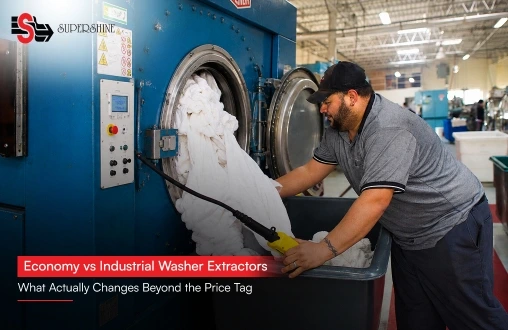
Economy vs Industrial Washer Extractors: What Actually Changes Beyond the Price Tag

You're standing between two washer extractors with the same capacity, similar dimensions, and a price difference that could be 30 to 50%. It's tempting to assume the cheaper one just has fewer bells and whistles. It doesn't. The gap between economy vs industrial washer extractors is mostly invisible until the machine has been running for a year or two, and by then the decision has already been made for you. At its core, this is a question of whether your operation genuinely needs a continuous-duty industrial washing machine or whether a lighter machine will do the job. The label on the spec sheet matters less than matching the machine to your real duty cycle. A standard commercial washing machine suits lighter, predictable volumes, while facilities running near-continuous shifts need genuinely heavy duty commercial washing machines built for that punishment. When buyers ask us to recommend the best heavy duty commercial washing machine for their volume, the honest answer starts with their actual cycles per day, not a brand name, and the same logic applies when comparing any industrial laundry washing machine against a lighter-duty alternative.
This matters most for smaller hotels, laundromats, and hostels, where every rupee of capital spend gets scrutinized and the instinct is to buy the lowest number on the quote. Sometimes that's the right call. Often it isn't. Supershine fields this exact question from cost-sensitive buyers regularly, so here's what's actually different, laid out so you can make that decision with real information instead of a guess.
Duty Cycle: The Number That Explains Everything Else
Every washer extractor is engineered around an assumed duty cycle, meaning how many hours per day and how many wash cycles it's expected to run without accelerated wear.
Economy washer extractors are typically built for one, maybe two shifts a day, somewhere around 6 to 10 wash cycles daily. That's a reasonable fit for a small hotel doing modest in-house linen volumes or a laundromat with predictable, moderate foot traffic. The frame, bearings, and motor are all sized to that lighter workload.
Industrial washer extractors are engineered for continuous, multi-shift operation, often 16 to 24 hours a day, 7 days a week, running dozens of cycles daily without a planned rest period for the machine. Everything downstream of that assumption, the bearing size, the frame gauge, the motor duty rating, gets built heavier because the design brief is different.
This is the root cause of almost every other difference on this list. It's not that industrial machines are "better" in some abstract sense. They're built for a workload the economy machine was never designed to survive.
What This Looks Like Inside the Machine
- Bearings. Industrial machines use larger, sealed, heavier-duty bearing assemblies rated for continuous operation, often supporting a 10-15+ year service life under proper maintenance. Economy machines use lighter bearings sized for intermittent use; pushed into a continuous-shift environment, bearing wear accelerates dramatically and premature failure becomes common well before that timeframe.
- Frame and drum construction. Industrial units generally use heavier-gauge stainless steel, often in a fully welded, reinforced frame designed to absorb sustained mechanical stress cycle after cycle. Economy models often use lighter gauge material and simpler frame fabrication, adequate for lighter use but more prone to fatigue under constant vibration loading.
- Motor and drive. Industrial machines typically use motors and drive systems rated for continuous duty, able to handle frequent starts, stops, and direction reversals without overheating. Economy machines often use motors sized closer to intermittent-duty ratings.
- Controls. Economy machines commonly ship with simpler mechanical or basic electronic controls and a smaller number of fixed programs. Industrial machines tend to offer programmable microprocessor controls, more wash program flexibility, and better data logging for cycle verification, which matters more as volume and compliance needs grow.
The Numbers That Actually Justify the Price Gap
Let's put this in terms a procurement head can actually use.
Say an economy washer extractor costs 30% less upfront but is realistically rated for 8 cycles a day before wear accelerates, while the industrial equivalent handles 20+ cycles a day at a similar wear rate. If your actual operational need is 18-20 cycles a day, running the economy machine at that pace doesn't save money, it just moves the cost from the purchase price into unplanned repairs, more frequent bearing replacement, and lost operating days when the machine is down.
That's the calculation that gets missed. Duty cycle mismatch, not the machine itself, is usually what turns a "cheaper" purchase into a more expensive one within 18 to 24 months.
A Simple Framework to Decide
- Count your actual daily cycles, realistically, not on your best day. Add a buffer for growth if you expect it.
- Compare that number against the duty cycle rating the manufacturer actually specifies for each machine, not the marketing capacity figure.
- Estimate downtime cost. What does an unplanned day without that washer extractor cost you in outsourced laundry, guest impact, or lost throughput?
- Factor in service and spare parts availability. A cheaper machine from a brand with thin after-sales support in your region can cost more in downtime than the purchase price ever saved.
- Look at total cost over 7-10 years, not just the invoice. Include expected bearing and component replacement, energy use per cycle, and water consumption differences.
When Economy Actually Makes Sense
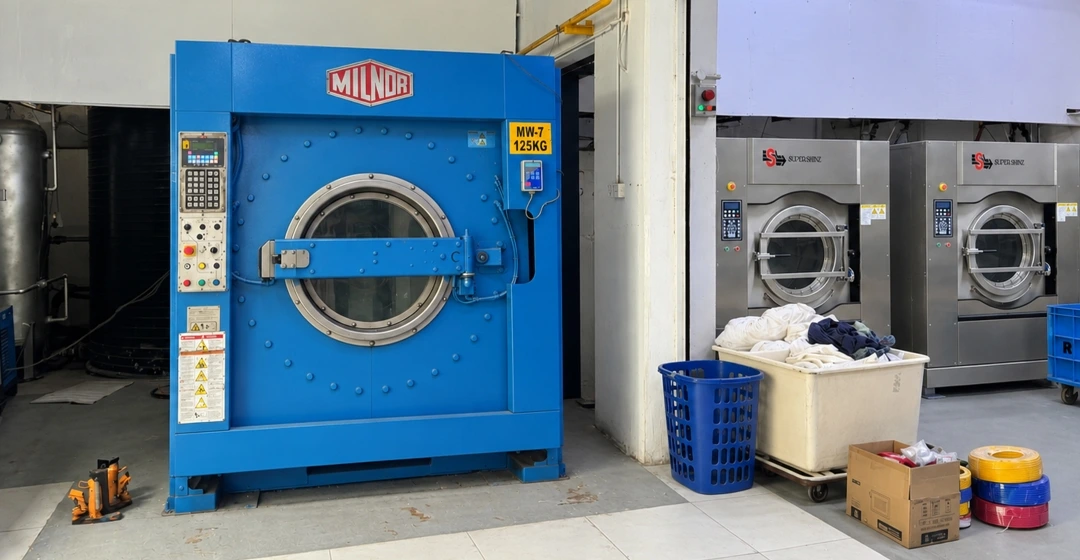
This isn't an argument that everyone needs an industrial machine. A small boutique hotel with 20-30 rooms doing one wash shift a day, a laundromat with steady but moderate customer volume, or a hostel with predictable, limited linen turnover can be genuinely well served by a properly specified economy washer extractor. The mistake isn't buying economy. It's buying economy and running it like an industrial machine, or buying industrial capacity you'll never actually use and paying for headroom that sits idle.
The honest exercise is matching the machine's design duty cycle to your real operational pattern, not your aspirational one.
Where the Lifecycle Math Gets Interesting
Energy and water efficiency differences compound this further. Industrial machines, particularly soft mount models with better extraction and more programmable rinse control, often use water and energy more efficiently per kilogram of linen processed over the long run, even though the upfront machine cost is higher. Over a 10-year operating life processing several thousand cycles, that efficiency gap can meaningfully offset part of the price difference, something that rarely shows up in a simple purchase-price comparison.
Supershine Laundry spends real time with smaller hotels, laundromats, and hostel operators walking through this exact duty cycle math before recommending a machine, because the wrong answer either way costs money. Sometimes that means confirming an economy washer extractor is genuinely the right fit. Other times it means showing a buyer why paying more upfront for an industrial-rated machine will save them from a repair bill and a bad guest experience eighteen months down the line. Supershine's after-sales and AMC support also plays into this decision, since the actual cost of ownership depends as much on service response time as on the machine itself.