+91-124-4807600
 contact@supershine.in
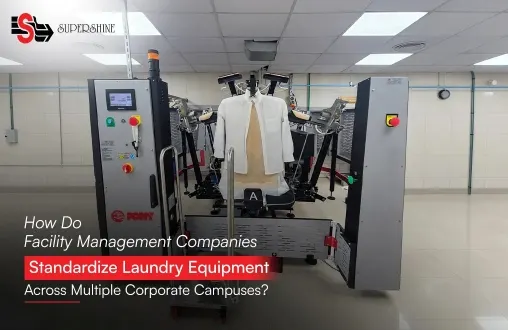
How Do Facility Management Companies Standardize Laundry Equipment Across Multiple Corporate Campuses?


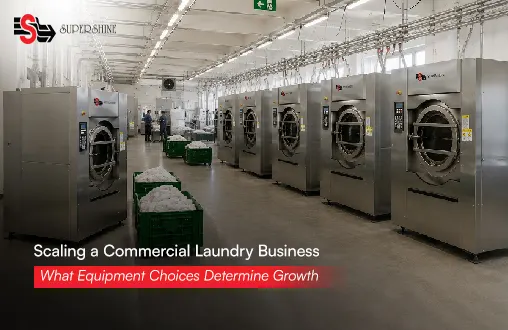
Facility management companies standardize laundry equipment across corporate campuses by locking a single machine specification (capacity, control platform, and brand) into their vendor contract, then repeating it at every site so spare parts, technician training, and service response stay identical regardless of location. This is managed through a master equipment schedule tied to one supplier relationship rather than separate purchase decisions per site. The result is predictable uptime and lower total cost of ownership across the entire portfolio, not just at any single property. Getting there starts with treating multi-site laundry as one connected set of commercial laundry solutions, not a series of independent local purchases. Standardization only works if the underlying equipment choice is sound at every site. That means locking in a consistent commercial laundry equipment specification across the portfolio, whether the individual site needs lighter industrial laundry equipment or a heavier-duty commercial laundry machine, so spare parts, training, and service stay identical campus to campus.
If you manage laundry operations across five, ten, or thirty corporate sites, you already know the alternative. Different machines bought at different times from different vendors, each with its own control panel, its own spare parts catalog, and its own service contact. It works until something breaks on a Friday evening at a site where nobody remembers who installed the machine.
Why Standardization Matters More at Scale
India's facility management sector has grown fast, with integrated FM contracts now routinely spanning multiple corporate campuses, business parks, and mixed-use developments under a single service umbrella. Industry estimates put India's facility management market in the multi-billion dollar range, growing at roughly 10 percent annually as more corporates outsource soft services (housekeeping, laundry, pantry) alongside hard services.
Laundry is a small line item in an FM contract's overall budget, but it's disproportionately visible when it fails. Soiled linen at a corporate cafeteria, uniforms not turned around for security staff, or towels missing at an on-site gym reflect directly on the FM company's service reputation, even though the equipment itself might be owned or maintained by a third party.
That's exactly why facility management laundry equipment decisions shouldn't happen site by site. A standardized fleet gives an FM operator three things a fragmented one can't:
- Predictable performance. Every site behaves the same way, so staff transferred between campuses don't need retraining on a different control interface.
- Consolidated spare parts. One bearing, one door seal, one drive belt across the fleet instead of a dozen SKUs sitting in different regional stores.
- Simplified vendor management. One AMC (Annual Maintenance Contract), one escalation path, one set of service level agreements instead of negotiating separately with local suppliers at every location.
The Standard Specification Approach
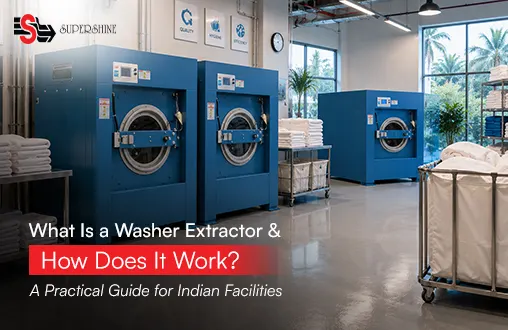
Most FM companies that get this right start with a technical specification document, not a shopping list. It defines washer extractor capacity bands (say, 25 kg for smaller campuses and 50 to 100 kg for larger ones), spin speed and G-force requirements, control system type, water and energy consumption ceilings, and preferred dryer pairing ratios.
That specification then becomes the baseline for procurement at every new site added to the portfolio. When a new corporate campus joins the FM contract, the laundry equipment order references the existing spec sheet rather than starting from scratch. Supershine works with several FM operators in exactly this way, supplying against a locked specification so that a machine installed in Pune this year matches the one installed in Gurugram three years ago in every operational respect.
Building the Spec Sheet Around Real Duty Cycles
A specification that ignores actual duty cycle data usually fails within a year. FM teams calculating standardized capacity need to look at:
- Peak daily linen or uniform load per site (kg), not average load
- Number of shifts and hours of laundry operation available per day
- Water pressure and electrical supply consistency across sites (a machine specified for one site's 3-phase supply won't necessarily behave identically at a site with voltage fluctuation issues)
- Redundancy requirements if a single machine going down means zero laundry capacity at that site
Getting this wrong in either direction is expensive. Oversized machines waste capital and run inefficiently at partial loads. Undersized machines hit their duty cycle limits early, and the fleet-wide standardization advantage disappears because that one site now needs a nonstandard exception.
Multi-Site Service Contracts: What Actually Gets Standardized
The equipment is only half the story. The service contract is where standardization either pays off or quietly falls apart.
A well-structured multi-site service contract for laundry equipment typically standardizes:
- Response time commitments that are identical across every campus, not better in metro cities and vague in tier-2 locations.
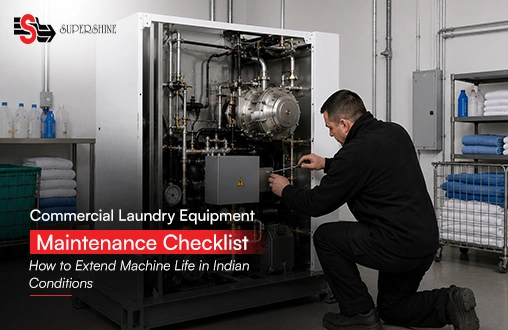
- Preventive maintenance schedules, so filter cleaning, bearing checks, and belt inspections happen on the same calendar logic everywhere.
- A single point of technical escalation, so an FM site engineer in Chennai and one in Noida call the same support desk rather than hunting for a local dealer.
- Consolidated AMC billing and reporting, which finance teams appreciate because it turns dozens of site-level invoices into one portfolio-level cost line they can actually forecast.
This is where spare parts commonality earns its keep. If every site runs the same washer extractor platform, a regional service technician can carry one parts kit that covers every campus on their route instead of maintaining separate inventories per brand or model. Supershine Laundry after-sales structure is built around this logic, with technicians trained across the standardized product line so a fault at one campus gets resolved with the same skill set and the same parts as a fault at another.
What Happens Without Standardization
FM companies that inherit a mixed fleet, often after taking over a contract from a previous operator, usually see three recurring problems: longer average repair times because technicians aren't familiar with every machine type, higher spare parts costs because nothing is bought in volume, and inconsistent service quality that shows up in tenant or occupant complaints. None of these are equipment failures in the traditional sense. They're standardization failures.
Making the Transition Without Disrupting Operations
FM companies rarely get to rip out an existing mixed fleet overnight. The practical approach is a phased standardization plan: new sites and equipment replacements follow the new specification immediately, while existing non-standard machines are cycled out on a replacement schedule tied to their remaining useful life. Over three to five years, the fleet converges toward one standard without a disruptive, budget-heavy single event.
This is also where working with one equipment partner across the transition matters. A supplier who understands the full portfolio, not just the site they're currently quoting for, can sequence replacements sensibly and avoid ordering machines that are technically compliant with the spec sheet but logistically awkward to service alongside the rest of the fleet.