+91-124-4807600
 contact@supershine.in
Hydro Extractors vs High-Speed Washer Extractors: Do You Need Both in Your Laundry Line?

Ask most facility managers what a hydro extractor is and you'll get a blank look, then a guess that it's just another name for a washer extractor. It isn't, and confusing the two is one of the more expensive mistakes we see in industrial laundry and garment-processing line design. This is a genuinely underserved topic in the laundry equipment conversation, so let's go through it properly, the way Supershine walks through it with clients specifying a full processing line rather than a single machine. Before deciding whether you need a dedicated hydro extractor at all, it helps to be clear on what your core extractor washing machine is already doing inside your line. This decision doesn't happen in a vacuum either. Whether your line runs a soft mount commercial laundry washer or a heavier industrial laundry washer, the extraction stage has to be sized against your actual dryer capacity, not against a spec sheet in isolation. A well-chosen commercial washing machine or industrial washing machine still needs disciplined commercial extractor maintenance to hold its rated G-force over time, and that upkeep is as much a part of your industrial laundry equipment investment as the hydro extractor decision itself.
Two Different Jobs, Not Two Names for the Same Machine
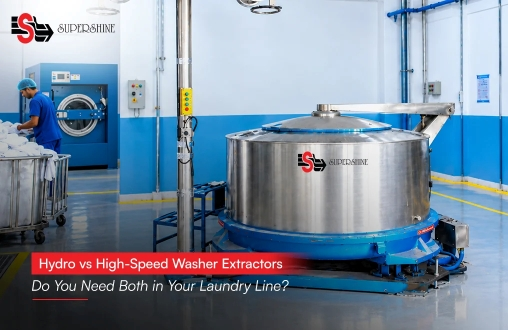
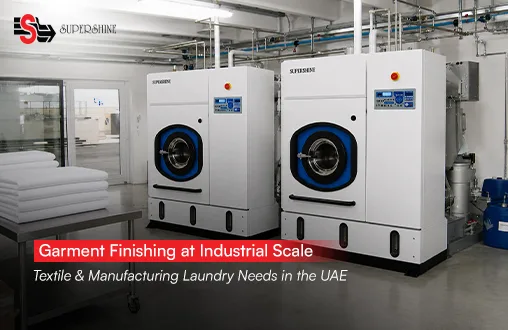
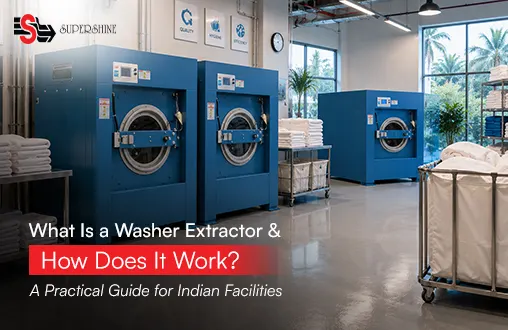
A washer extractor does two jobs in one drum: it washes the load, then spins that same drum at high speed to extract water, all inside a single chamber. A hydro extractor does one job only, and does it hard: it's a dedicated centrifugal spinning machine with no wash function at all. You load already-washed, water-saturated fabric into it, and it removes water through pure centrifugal force, nothing else.
That single-purpose design lets a hydro extractor spin faster and harder than the extraction cycle of a combined washer extractor. Where a soft mount washer extractor's extraction phase typically runs in the 300-450 G-force range as part of its wash cycle, a purpose-built hydro extractor, freed from having to also handle wash chemistry, water fill, and mechanical action, can be engineered for very high sustained G-force focused entirely on moisture removal, often significantly outperforming what a combined machine achieves in its own spin phase.
Where Hydro Extractors Actually Show Up
Hydro extractors aren't a replacement for washer extractors. They show up as a dedicated stage in specific line configurations:
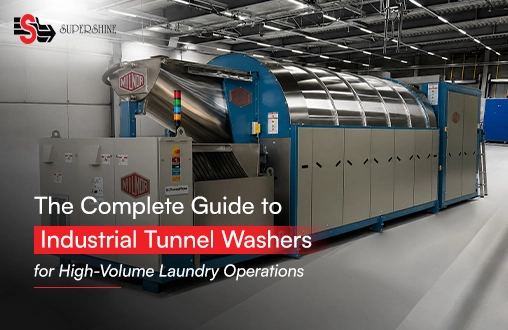
- After tunnel washing systems. Continuous batch tunnel washers process fabric through wash zones but don't extract water themselves; the saturated fabric moves to a press or a hydro extractor as a separate mechanical step before drying.
- In garment dyeing and finishing lines. Garments processed in dyeing machines, softening vats, or open-pocket finishing equipment often need a dedicated high-speed spin stage afterward, since the processing vessel itself isn't built for extraction.
- For delicate or high-value loads. Certain garment categories benefit from separating the gentler wash mechanics from a harder, more controlled extraction step, rather than subjecting the fabric to the combined stresses of a washer extractor's own spin cycle.
- As a capacity buffer. In high-volume operations, a standalone hydro extractor can pull moisture out faster than waiting for washer extractor spin cycles to finish, keeping fabric moving toward the dryer without idle time.
The Real Question: Is Your Bottleneck Washing or Drying?
This is where the “do you need both” question actually gets answered, and it’s rarely a marketing decision. It’s a throughput calculation.
Industrial dryers are almost always the slowest step in a laundry line, because thermal drying takes meaningfully longer than either washing or mechanical extraction. If your industrial laundry washer or washer-extractor is already pulling residual moisture down to a reasonable range, say somewhere between 45 and 55% depending on fabric type, adding a hydro extractor to squeeze out another few percentage points of moisture usually doesn’t move your overall line throughput much, because the dryer was always going to be the pace-setter.
Where a hydro extractor earns its place is different: it’s when your process itself doesn’t include an extraction step, because the prior machine wasn’t built for it (such as tunnel washers, dyeing units, or some finishing equipment), or when you’re running a garment category where separating washing and extraction genuinely improves quality or fabric handling.
In those cases, skipping the hydro extractor doesn’t necessarily save money. It just moves wet, heavy fabric to the dryer inefficiently, which can increase drying time and energy cost per cycle far more than the machine you skipped would have cost.
A Practical Way to Decide
Walk through these questions before you spec your line:
- Does your primary washing equipment already include an integral extraction cycle?
If yes (standard washer extractors), a hydro extractor is usually additive, not essential, unless throughput math says otherwise. - Are you running a tunnel washer, dyeing machine, or finishing equipment without built-in extraction?
If yes, a hydro extractor (or press) is not optional, it's a missing stage in your process. - What's your actual dryer capacity relative to washing capacity? If dryers are already the constraint, investing further in extraction technology won't fix your throughput problem. Fix the drying stage first.
- What residual moisture does your current process leave, and does it meet your production targets?
If ironers or finishing equipment downstream need lower moisture than your current extraction delivers, that's a legitimate reason to add a dedicated hydro extraction stage. - What's your fabric mix?
Heavier fabrics like denim or terry toweling benefit more from a dedicated high-G extraction stage than lighter garments that dry quickly regardless.
Cost and Space Reality
A standalone hydro extractor is an additional capital line item, plus floor space, plus another point of material handling in the line, which usually means another operator touch or another conveyor segment. That's not a small decision in a facility where floor space and labor are both already tight.
The businesses that get the most value from adding a hydro extractor are ones with high-volume, continuous processing, garment manufacturing units, large-scale textile processing operations, or industrial laundries running tunnel systems, where the extraction stage genuinely doesn't exist elsewhere in the line. For a standard hotel or hospital laundry running a bank of washer extractors feeding directly into tumble dryers, a hydro extractor is very likely an unnecessary spend. The integral extraction cycle in a properly specified washer extractor is doing that job already.
Supershine Laundry works through this exact throughput analysis with garment manufacturing and industrial laundry clients before recommending equipment, because the honest answer is often "you don't need a hydro extractor, you need a better dryer" or vice versa. Getting that sequencing right, rather than defaulting to the most feature-rich line configuration, is what actually protects the project's ROI. Supershine's engineering team maps the full line, washing through finishing, before any single machine gets specified.