+91-124-4807600
 contact@supershine.in
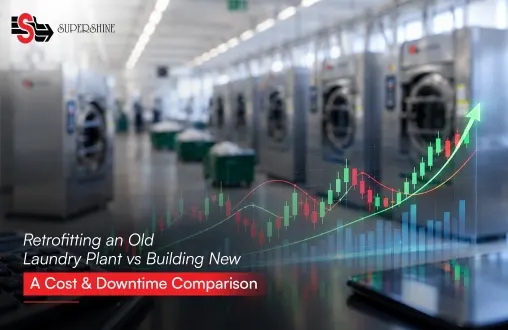
Retrofitting an Old Laundry Plant vs Building New: A Cost and Downtime Comparison

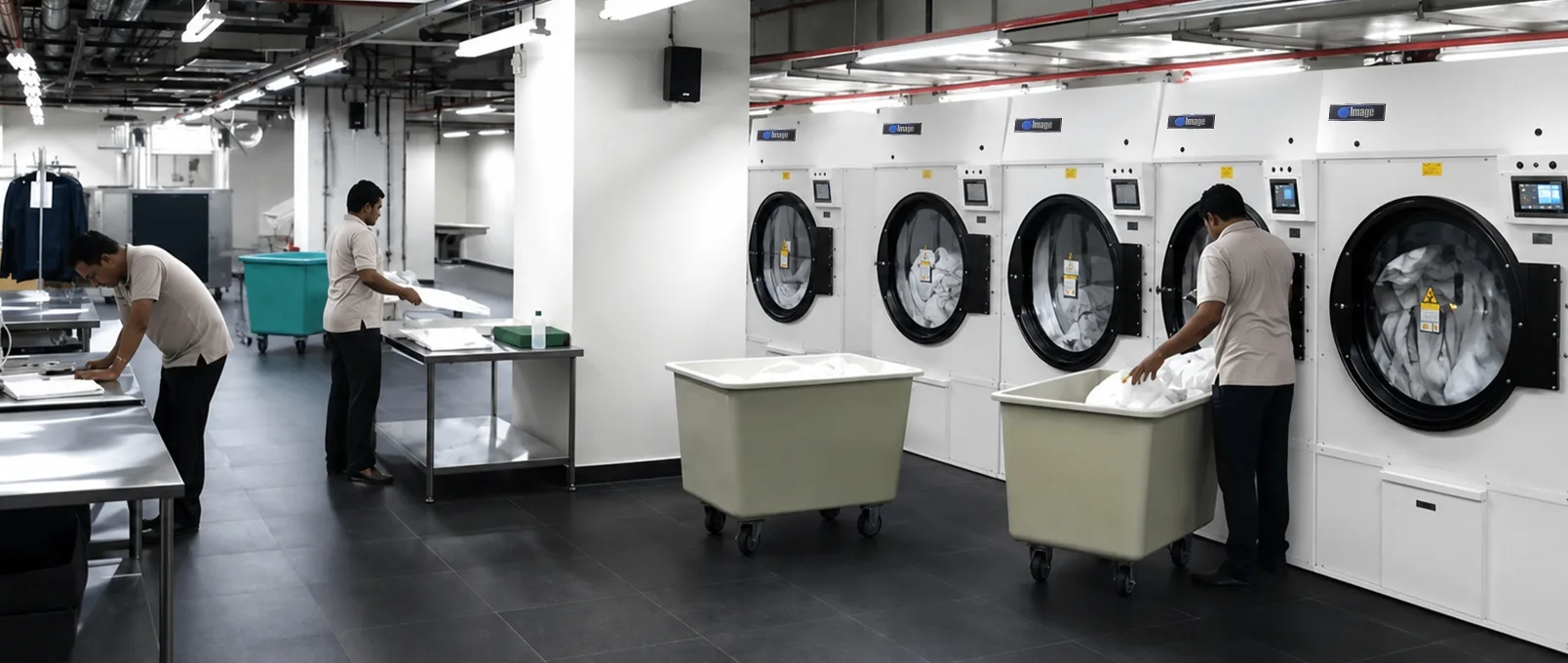
Somewhere around the ten to fifteen year mark, every in-house laundry hits the same wall. Machines that used to run reliably now need parts that take weeks to source. Repair bills creep upward. Water and power bills climb even though volume hasn't. At some point, someone in finance asks the obvious question: do we fix this, or do we rebuild it properly? Answering that well means being honest about the real condition of your existing industrial laundry equipment, not just its age on paper. Whichever path you choose, the equipment decision itself doesn't get any simpler. A retrofit or a new build both mean re-specifying commercial laundry equipment for the space you'll actually have, matching industrial laundry machines to real volume, and confirming your industrial washing machine and industrial dryer machine choices fit the utilities available. If capital is tight, exploring commercial laundry equipment financing structures alongside the retrofit-versus-rebuild decision can ease the upfront outlay, and either way, locking in proper commercial extractor maintenance from day one protects whichever equipment you end up installing.
Retrofit laundry plant vs new build isn't a question with one universal answer, it depends heavily on your building, your budget cycle, and how much downtime your operation can actually absorb. This piece lays out the real cost and downtime tradeoffs so you can make that call with numbers instead of gut feel, drawing on the kind of structural and utility assessments Supershine runs with hotel and hospital groups before recommending either path.
When repair stops making financial sense
Commercial washer extractors and ironers typically have a useful working life of 10 to 15 years under normal duty cycles, though well-maintained machines can run considerably longer, especially in lower-utilization settings. The number that actually matters, though, isn't age. It's the repair-to-replacement cost ratio.
A widely used rule of thumb: once a single repair, or the cumulative repair spend over a rolling period, approaches 50 percent of the cost of a comparable new machine, you're in replacement territory, not repair territory. Below that, keep repairing. Above it, you're just delaying an inevitable capital expense while paying interest on it in the form of unplanned downtime.
There's a second, quieter cost that doesn't show up on a repair invoice: energy and water efficiency. Older washer extractors typically run lower extraction speeds, meaning wetter loads go into the dryer, meaning longer drying cycles and higher energy use per kilogram processed. Modern machines with higher G-force extraction and moisture-sensing dryer controls can meaningfully cut both water and energy consumption per cycle compared to equipment from even 12 to 15 years ago. That efficiency gap compounds daily, across every load, for the entire remaining life of the old machine.
Retrofit: lower cost, faster timeline, more constraints
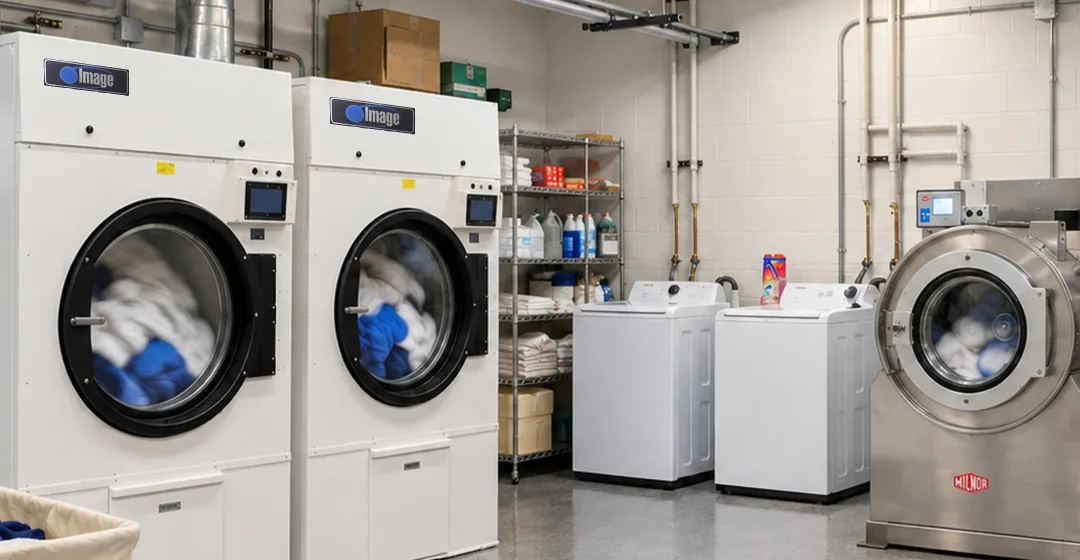
Retrofitting an existing laundry space, replacing equipment and upgrading utilities within the current building footprint, is almost always the faster and cheaper path on paper. You're not buying land, not going through a fresh zoning and environmental approval cycle, and in many jurisdictions you benefit from grandfathering provisions that let you avoid some current-code requirements that would otherwise apply to new construction.
But retrofits carry hidden costs that catch a lot of operators off guard:
- Code compliance triggers. Buildings more than 15 to 20 years old often don't meet current fire, electrical, or accessibility codes. A retrofit that disturbs enough of the structure can trigger a requirement to bring the whole space up to current code, not just the laundry area. This has, in real projects, added costs running into tens of thousands of dollars for items like accessible access or upgraded fire suppression that weren't part of the original laundry budget at all.
- Structural and space limits. You're working within existing ceiling heights, column spacing, floor loading capacity, and drainage layout. If your new equipment needs 4.5 metres of clear height and your building has 3.5, that's not a retrofit problem, that's a rebuild problem.
- Utility capacity ceilings. Existing electrical service, water supply lines, and steam boiler capacity were sized for the old equipment. Higher-efficiency modern machines sometimes need different utility profiles (different voltage, different water pressure, different steam demand curves) than what's already run to the room.
When retrofit is clearly the right call
- The building structure, ceiling height, and utility capacity can genuinely support modern equipment without major structural work.
- The laundry footprint doesn't need to expand to meet current or near-future volume.
- Budget cycles favor a lower capital outlay now over a larger one spread across a longer approval and construction timeline.
- The facility can tolerate a defined, planned downtime window (see below) without major operational disruption.
New build: higher cost, more design freedom, longer timeline
Building a new laundry facility, whether as a standalone structure or a purpose-built space within a larger new development, removes almost every constraint a retrofit imposes. Ceiling height, column placement, dock access, drainage slope, and utility routing can all be designed around the equipment from day one instead of forcing equipment to fit an inherited space.
The tradeoffs are real, though:
- Higher capital cost. New construction typically costs meaningfully more than retrofit per square metre of finished, equipped laundry space, once you account for structure, envelope, and full utility infrastructure from scratch.
- Longer approval timeline. Zoning approval, environmental review, and fire and building department sign-off for new construction can take considerably longer than a retrofit permit process, sometimes stretching a project timeline by many months before construction even begins.
- Design freedom translates to better long-term economics, though. A laundry built for its actual equipment, rather than equipment squeezed into an inherited room, tends to run more efficiently for its entire operating life, better workflow, better utility sizing, better headroom for future capacity growth.
The downtime question nobody wants to answer honestly
This is where the real operational risk lives, and it's different for a hotel, a hospital, and a standalone commercial laundry.
Full shutdown and rebuild in place gives you the cleanest, fastest construction timeline, but it means zero in-house laundry capacity for the duration, typically weeks to a few months depending on scope. For a hospital, this usually isn't viable at all given infection-control and continuity requirements. For a hotel, it means outsourcing to a contract laundry for the duration, which has its own cost and quality-control tradeoffs.
Phased retrofit, replacing and commissioning equipment in stages while keeping part of the plant running, takes longer overall but avoids a complete shutdown. This is the approach most hospitals and larger hotels choose, even though it typically costs more in project management and temporary workaround logistics than a clean full rebuild would.
A practical framework for deciding:
- Calculate your outsourcing cost per day of full shutdown, including contract laundry rates and any quality or turnaround risk to guest or patient experience.
- Compare that against the added cost and timeline of a phased approach. If phased retrofit adds, say, six weeks to the project but saves you from six weeks of full outsourcing costs and quality risk, the math usually favors phasing for any facility that can't fully outsource cleanly.
- Identify your minimum viable in-house capacity during the transition, even partial in-house capacity for essential items (patient gowns, kitchen linen) while outsourcing the rest can meaningfully reduce both cost and risk during the changeover.
What this looks like in practice
Supershine Laundry has worked through this exact decision with hotel groups and hospital facilities modernizing aging laundries, and the pattern holds consistently: the "cheaper" option upfront isn't always cheaper once you price in the code compliance surprises on a tight retrofit, or the extended outsourcing costs on a full rebuild. The right call depends on an honest structural assessment of the existing building, a realistic downtime tolerance for your operation, and a full lifecycle cost comparison, not just the equipment quote.
A structural and utility audit of the existing space, done before committing to either path, is the single highest-value step in this decision. It tells you definitively whether retrofit is structurally viable at all, before you've sunk design fees into a plan that turns out to need a new roof to accommodate ceiling height.