+91-124-4807600
 contact@supershine.in
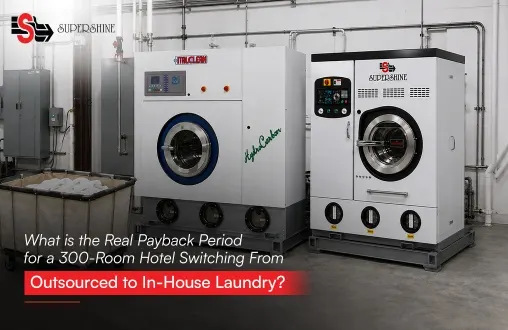
What Is the Real Payback Period for a 300-Room Hotel Switching From Outsourced to In-House Laundry?

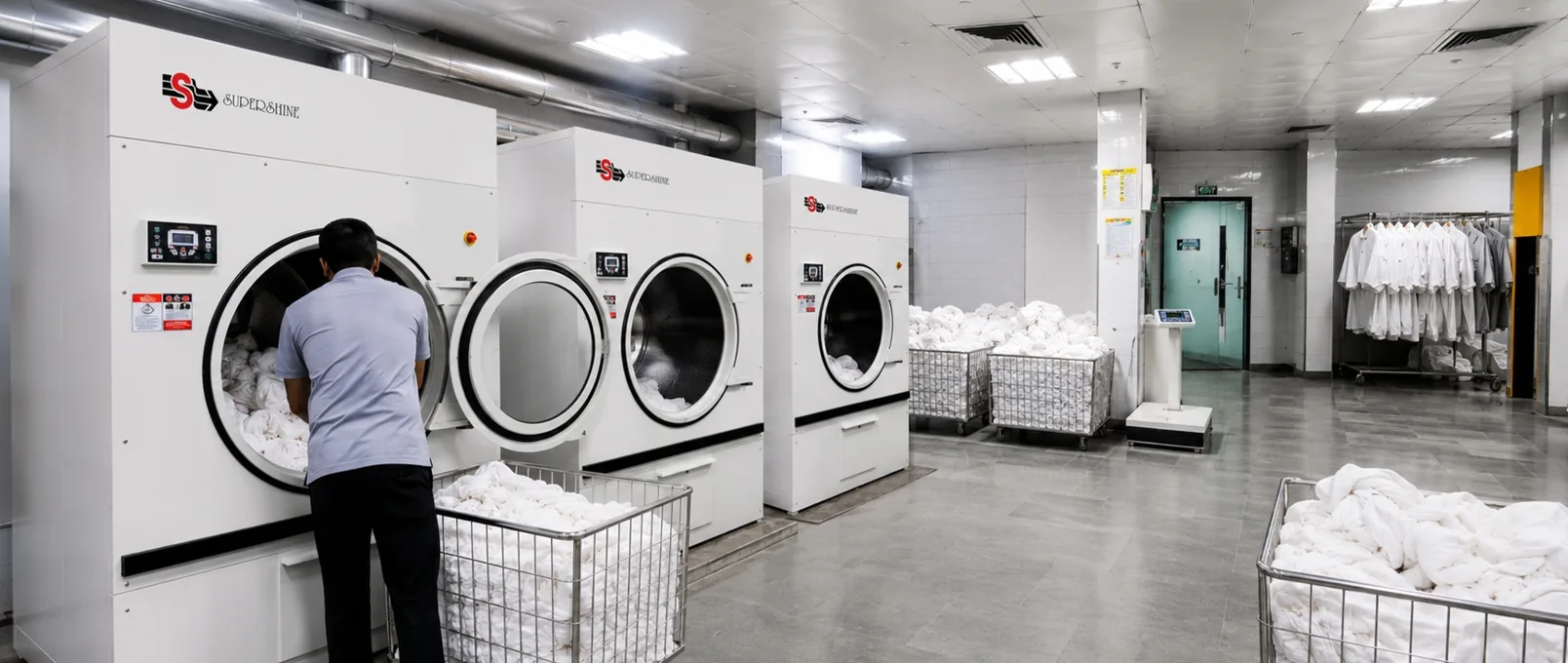
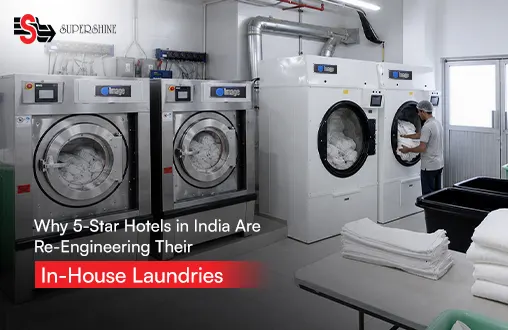
For a 300-room full-service hotel running moderate to high occupancy, switching from outsourced to in-house laundry typically pays back its equipment investment in 18 to 30 months, based on realistic capex, operating cost, and outsourced-rate assumptions. The exact number moves with your occupancy, local outsourced contract rates, and utility costs, but the underlying math consistently favors in-house operations once daily linen volume crosses roughly 1,000 to 1,500 kg a day. Below is a worked illustrative model showing exactly how that number gets built, with every assumption stated so you can substitute your own numbers. That payback math changes considerably depending on how you specify your hotel laundry machines, so the equipment side of this decision deserves the same rigor as the financial model. The capex table above is only as good as the equipment choices behind it. Sourcing genuinely efficient laundry machines for hotels, sizing the right hotel commercial washing machine capacity, and confirming your supplier can support commercial laundry equipment for hotels long after installation all affect whether your real payback lands closer to 18 months or stretches toward 30. The same applies to drying and finishing capacity: undersized hotel industrial washing machines paired with mismatched dryers will erode the efficiency gains this model assumes.
Let's be upfront about something: any payback figure you read online, including this one, is a model, not an audit of your property. The value here isn't the exact number. It's the method, so you (or your finance team) can plug in your actual occupancy and rates and get a figure you can trust.
The Core Question: What Are You Actually Comparing?
Outsourced laundry looks simple on paper. You pay a per-kg rate, someone picks up soiled linen, and clean linen comes back. No capex, no staff to manage, no machines breaking down at 2 AM.
In-house laundry flips that structure. You take on capital expenditure and daily operating costs (water, power, chemicals, labor, maintenance) in exchange for a lower cost per kilogram processed and full control over turnaround and quality.
The payback period is simply: capex divided by the annual savings from switching. Getting a realistic number requires being honest about both sides of that equation, not just the flattering one.
Building the Illustrative Model
Here are the assumptions this model uses. Change any of them and the payback shifts, which is exactly the point.
Property assumptions: 300 keys, 65 percent average annual occupancy (roughly 195 occupied rooms per night). Linen generation of 6 kg per occupied room per day (sheets, towels, pillowcases), plus F&B linen, staff uniforms, and banquet/event linen adding roughly 350 kg per day. Combined average daily volume: approximately 1,500 kg per day.
Outsourced baseline: Illustrative bulk contract rate of ₹28 per kg (wash, dry, fold or iron, pickup and delivery), a realistic mid-range figure for a metro or tier-1 Indian city on a hotel-scale contract, though rates in practice range roughly ₹20 to ₹40 per kg depending on city and linen mix. Annual outsourced cost: 1,500 kg x 365 days x ₹28 = approximately ₹1.53 crore per year.
Estimating In-House Capex
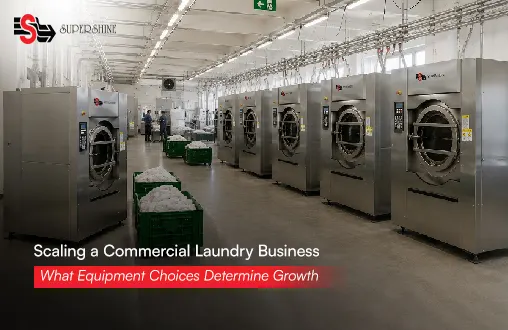
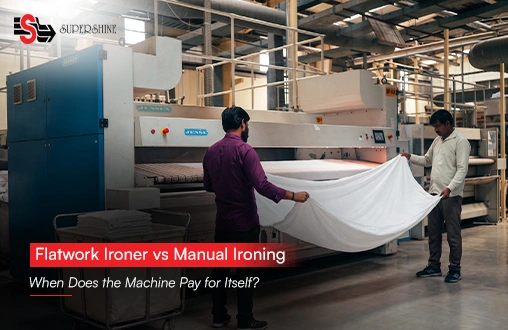
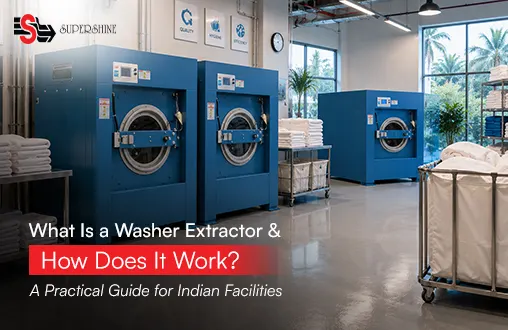
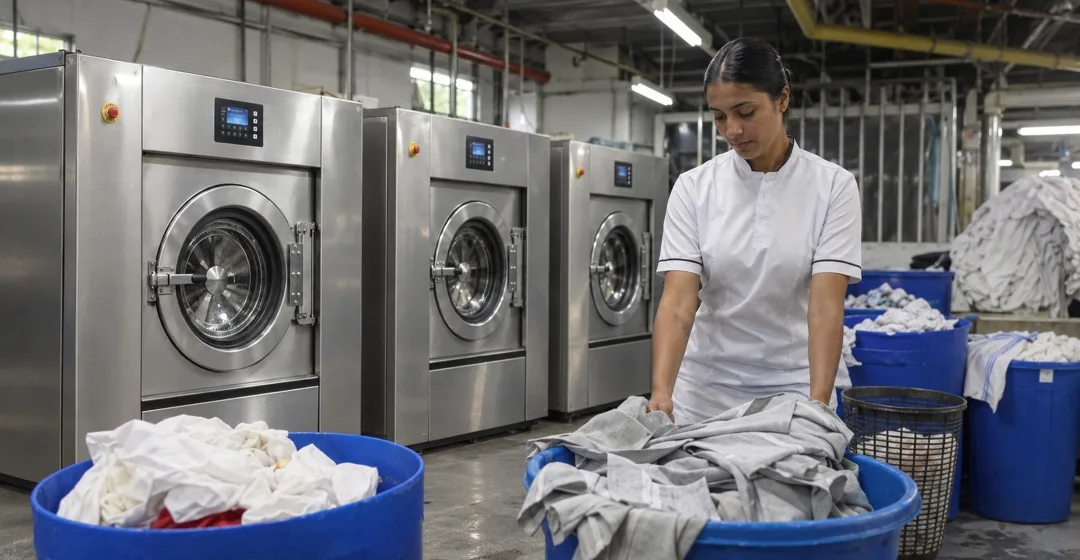
A washer extractor, dryer, and flatwork ironer setup sized for this volume typically includes two or three washer extractors in the 50 to 100 kg range (a mix of soft mount for general linen and a barrier or hard mount unit for isolation or heavy-soil loads), matching tumble dryers, one flatwork ironer for bedsheets and table linen, plus utilities like a steam source, water treatment, and electrical work.
| Equipment / setup item | Illustrative cost (INR)
|
|---|---|
| 2x 50 kg soft mount washer extractors | ₹35 lakh |
| 1x 100 kg barrier washer extractor | ₹28 lakh |
| 3x matching tumble dryers | ₹18 lakh |
| 1x flatwork ironer (roll type) | ₹22 lakh |
| Utilities, boiler/steam, water treatment, civil, electrical | ₹35 lakh |
| Total illustrative capex | ₹1.38 crore |
These figures are illustrative and will vary by brand, capacity mix, and site conditions. A property with existing utility infrastructure (steam, water treatment already in place) will see meaningfully lower capex than one starting from a bare floor.
Estimating Annual In-House Operating Cost
- Water and softening: roughly 7 to 8 liters per kg processed with efficient soft mount machines, working out to approximately ₹6 lakh per year at typical treated-water costs
- Power (dryers, ironer, boiler load): approximately ₹9 lakh per year
- Detergent and laundry chemicals: roughly ₹3.5 to ₹4 per kg processed, approximately ₹20.5 lakh per year
- Labor: 6 to 8 laundry staff (washer operators, ironer operators, sorters, a supervisor) at a fully loaded average cost, approximately ₹16.8 lakh per year
- Maintenance and AMC: roughly 5 percent of capex annually, approximately ₹7 lakh per year
Total illustrative annual operating cost: approximately ₹59 to ₹60 lakh per year
Running the Payback Calculation
With these illustrative numbers:
- Annual outsourced cost: ₹1.53 crore
- Annual in-house operating cost: ₹0.60 crore
- Annual savings from switching: approximately ₹0.93 crore
- Capex: ₹1.38 crore
- Payback period: 1.38 / 0.93 = approximately 1.5 years (about 18 months)
That's on the faster end of the realistic range, which makes sense given the relatively high assumed occupancy and volume in this model. Properties with lower average occupancy, a lower outsourced baseline rate, or higher local utility costs will see payback stretch toward 24 to 30 months instead. Very few well-run, high-volume properties in this segment see payback beyond 3 years unless the outsourced rate they're currently paying is unusually low.
What Moves the Number Most
If you're modeling your own property, these variables have the biggest swing effect on payback:
- Occupancy and linen volume. A property running 45 percent occupancy instead of 65 percent sees proportionally lower savings and a longer payback, since fixed capex doesn't scale down with volume.
- The outsourced rate you're currently paying. This varies significantly by city and contract negotiation. A property already getting a competitive ₹18 to ₹20 per kg rate has a smaller gap to close than one paying ₹35 plus.
- Labor cost assumptions. Metro cities carry higher laundry staff costs than tier-2 or tier-3 locations, which affects the in-house side of the equation directly.
- Whether utility infrastructure already exists. A hotel with existing boiler capacity and water treatment sized for laundry use avoids a large chunk of the capex line entirely.
Costs the Model Above Doesn't Capture
A capex-versus-opex model like this is useful, but it's not the whole picture. Two things worth weighing beyond pure payback math:
- Quality and turnaround control. In-house laundry means no more chasing an outsourced vendor over damaged linen, missed deliveries during a banquet weekend, or inconsistent finishing quality. This has real revenue protection value that's hard to put a number on but shows up in guest satisfaction scores.
- Risk of vendor dependency. Hotels relying entirely on one outsourced vendor carry operational risk if that vendor has capacity issues, a facility shutdown, or a dispute. In-house operations remove that single point of failure.
This is exactly where working with an experienced equipment and planning partner matters. Supershine Laundry builds these feasibility models against a property's actual occupancy history and current outsourced spend, rather than industry averages, which is the only way to get a payback number worth taking to a hotel's finance committee. The illustrative numbers above are a starting framework, not a substitute for that property-specific exercise.
Hotel groups that have gone through this exercise with Supershine's planning team typically find that the biggest correction to their own back-of-envelope math isn't the equipment cost, it's the outsourced baseline they were comparing against. Many properties underestimate what they're actually paying once pickup, delivery, damage replacement, and rush charges during peak season are all added up.