+91-124-4807600
 contact@supershine.in
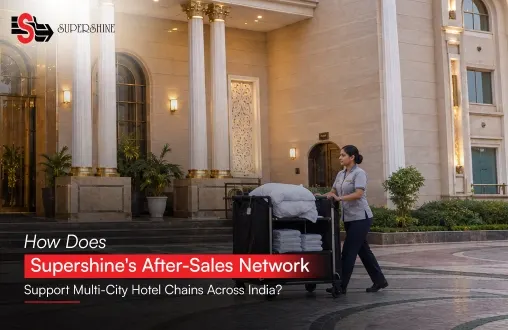
How Does Supershine's After-Sales Network Support Multi-City Hotel Chains Across India?

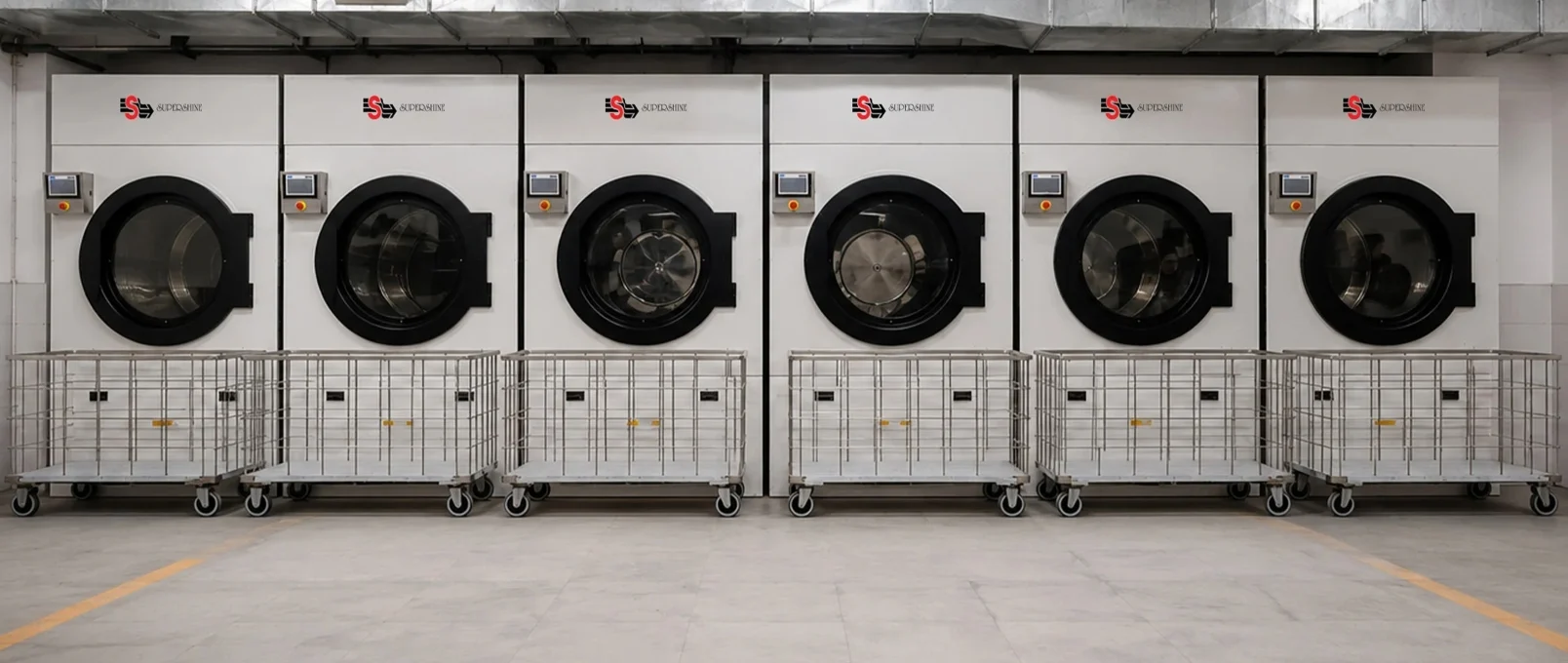
Supershine's after-sales network supports multi-city hotel chains through a structured AMC (Annual Maintenance Contract) covering quarterly inspections, annual deep servicing, and emergency priority response for contracted properties, backed by stocked spare parts and equipment-specific engineers across North, Central, West, and South India. For a hotel group operating properties in five or ten different cities, this means the same service standard applies at every location, coordinated through one relationship rather than a different local vendor per city. That consistency, not any single machine feature, is usually what decides the vendor conversation for chain-level procurement heads. That consistency starts with standardising the hotel laundry machines themselves across every property in the portfolio. Service quality and equipment standardisation reinforce each other. A chain running the same hotel commercial washing machine platform at every property makes it far easier for a vendor to stock common parts and train technicians once, rather than separately for every property's own commercial laundry equipment for hotels mix. That's exactly why hotel groups increasingly ask about fleet-wide hotel industrial washing machines standardisation in the same conversation as AMC coverage.
If you're a procurement head at a hotel group with properties spread across the country, you already know the real question isn't "which washer extractor is best." It's "who's going to show up when a machine goes down in a city where we don't have our own engineering team on-site."
Why Service Coverage Beats Machine Specs for Hotel Chains
A single-property hotel can pick equipment on performance and price and manage the service relationship locally. A multi-city chain doesn't have that luxury. Laundry downtime at one property doesn't stay contained. It shows up in guest complaints, housekeeping delays, and F&B linen shortages, and it repeats at every property that shares the same equipment gap.
That's why hotel chain procurement teams increasingly evaluate laundry equipment vendors the way they'd evaluate an IT or facilities vendor: on service level agreements, geographic coverage, and escalation structure first, with equipment specifications as a secondary filter among vendors that clear the service bar.
India's organized hotel sector has kept expanding its multi-city footprint. Chains like IHCL and Lemon Tree have continued opening properties across new cities in recent years, which means the laundry equipment vendors serving them need to scale service coverage at the same pace as the portfolio, not lag behind it by a city or two.
The AMC Structure Behind Multi-City Support
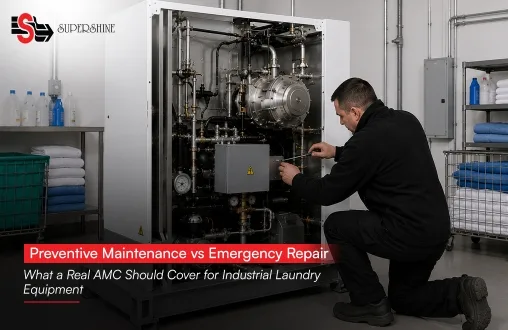
An laundry equipment AMC built for a hotel chain needs to do more than promise a technician visit when something breaks. Supershine's after-sales structure for contracted facilities runs on three maintenance tiers:
- Quarterly inspection. Scheduled preventive checks on bearings, seals, drive components, and control systems, catching wear before it becomes downtime.
- Annual deep service. A more thorough overhaul covering components that don't need quarterly attention but do need annual verification, extending machine life meaningfully beyond what reactive-only maintenance achieves.
- Emergency priority response. For contracted facilities, breakdowns get prioritized ahead of non-contract service calls, which matters enormously when a 300-room property's entire linen supply depends on one washer extractor that's just gone down.
This tiered structure is what lets a hotel chain treat laundry uptime as a managed, predictable line item across its whole portfolio instead of a per-property gamble.

What "Nationwide" Actually Means in Practice
"Pan-India service" is a phrase every equipment vendor uses. The difference between a real claim and a marketing one is whether the coverage map has actual depth in the cities where your properties sit, not just a head office and a courier account.
Supershine's after-sales operation is structured across regional coverage zones, including North and Central India (anchored around the Delhi NCR base), West India, and South India, supported by a nationwide logistics and service network for spare parts movement and technician dispatch. For a hotel group with properties in, say, Gurugram, Mumbai, and Bengaluru, that regional structure means each property gets a technician response grounded in local presence rather than someone flown in from a single national hub every time.
Spare Parts Commonality Across a Chain's Properties
Response time only matters if the technician arrives with the right part. This is where spare parts availability becomes the quieter but more decisive factor in multi-city service quality.
A hotel chain that standardizes its laundry equipment across properties, running the same washer extractor and dryer models at each city, gives its service vendor the ability to stock common parts regionally rather than sourcing a different component for every property's unique machine mix. Supershine Laundry services equipment across major brands including Milnor, Image, Forenta, ADC, LACO, and Pony, and stocks spare parts against this range so that a repair at one property doesn't stall on a part that has to be imported or shipped from another city.
For chains still running a mixed fleet inherited from different renovation cycles or acquired properties, this is often the strongest argument for gradually standardizing equipment specification across the portfolio, since it directly shortens the average repair time everywhere.
What Hotel Chain Procurement Teams Should Actually Ask
When evaluating a vendor for multi-city laundry equipment and service, a few questions separate a vendor that can genuinely support a chain from one that can only support a single property well:
- What's the guaranteed response time for an emergency breakdown at a contracted property, and does that commitment hold in every city the chain operates in, not just metros?
- Are spare parts stocked regionally, or does every part request route through one central warehouse?
- Is there a single point of contact for the whole chain's AMC, or does each property manage its own vendor relationship separately?
- What's covered under preventive maintenance versus billed separately as a repair?
- Can the vendor provide consolidated service reporting across all properties for the chain's facilities or engineering leadership to review?
Real Coverage Reflects in Real Projects
Supershine's project history includes properties across different hospitality groups and cities, among them the Taj Mahal Palace in Mumbai, Grand Hyatt Gurgaon, and Holiday Inn Aerocity in New Delhi. That spread across ownership groups and cities is a reasonable proxy for what a chain-level service relationship actually needs: a vendor whose engineering and service capability isn't concentrated in one region or one property type.
Training and Remote Support as Part of the Service Layer
After-sales support for a multi-city chain isn't only about physical technician visits. Operator training at each property, covering wash-cycle management, routine fault recognition, and basic maintenance, reduces the number of service calls that need a technician dispatch at all. Combined with remote diagnostics support through a 24/7 helpline, many issues get triaged or resolved before they escalate into an on-site emergency visit.
This layered approach, training plus remote support plus scheduled maintenance plus emergency response, is what keeps average downtime manageable across a portfolio that might span a dozen cities and several different property types, from a business hotel to a resort with heavier F&B linen loads.