+91-124-4807600
 contact@supershine.in
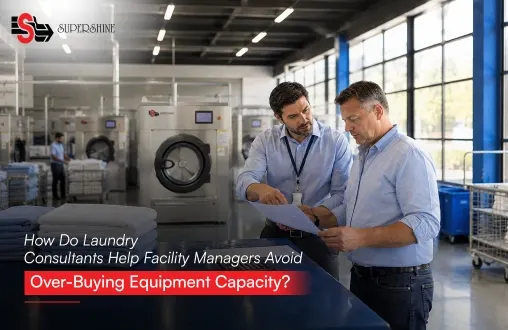
How Do Laundry Consultants Help Facility Managers Avoid Over-Buying Equipment Capacity?


Laundry consultants help facility managers avoid over-buying equipment capacity by replacing gut-feel purchasing with actual load-calculation math, specifically peak versus average daily volume, real duty cycle capacity, and honest redundancy planning. Instead of sizing a laundry room around the busiest day of the year, a consultant sizes it around sustainable peak throughput with a controlled buffer, which typically cuts planned capex by 20 to 35 percent compared to a self-specified purchase. That gap is usually where the consulting fee pays for itself several times over. Getting the sizing math right up front is what keeps a commercial laundry equipment purchase matched to real need instead of worst-case guesswork. That discipline matters whatever the facility type. A consultant sizing commercial laundry solutions for a hotel, hospital, or institutional client applies the same peak-versus-average logic whether the recommendation lands on lighter industrial laundry equipment, a mid-range commercial laundry machine, or a full-capacity commercial washing machine fleet. The math doesn't change. Only the numbers going into it do.
Here's the thing nobody tells you when you're buying laundry equipment for the first time: every vendor quote you get will be technically correct and still wrong for your building. Correct because the machine will run and wash clothes. Wrong because it was sized off a number someone guessed, not calculated.
Why Facility Managers End Up Over-Buying
Most over-buying doesn't come from bad intentions. It comes from three predictable habits.
- Sizing for the worst day, every day. A 250-room hotel with 40 percent average occupancy still gets specified for 100 percent occupancy "just in case," which means the washer extractor fleet sits underutilized 300+ days a year.
- Ignoring dryer and ironer ratios. Buyers often size the washer correctly and then match dryers and flatwork ironers one-to-one, when the actual processing time relationship between wash, dry, and finish stages is rarely 1:1.
- Skipping duty cycle math entirely. A machine's rated capacity per load means little without knowing how many loads it can actually complete in an operating shift.
A laundry consultant exists precisely to catch these habits before they turn into a six-figure capex line that runs at 50 percent utilization for the next decade.
The Real Load-Calculation Logic
This is where the actual value shows up, and it's worth walking through the math because it's not complicated, just rarely done properly.
Step 1: Separate Peak Load From Average Load
Average daily linen volume tells you almost nothing useful for sizing. What matters is peak load, defined as your busiest realistic operating day, not your theoretical maximum. For a hotel, that's usually a high-occupancy weekend with a banquet event running simultaneously, not a hypothetical 100 percent occupancy night that happens twice a year.
A consultant typically pulls 12 months of actual linen or laundry volume data (in kg processed per day) and identifies the 90th or 95th percentile day, rather than the absolute maximum. Sizing for the true outlier day means paying for capacity that sits idle almost every single day of operation.
Step 2: Calculate Real Duty Cycle Capacity
Duty cycle calculation is where most self-specified purchases go wrong. A washer extractor's rated capacity (say, 50 kg) is a per-load figure, not a per-hour or per-shift figure. The real question is: how many completed cycles can that machine run in your available operating hours?
A typical commercial wash cycle for standard soil linen runs 30 to 45 minutes end to end, including load and unload time. Over an 8-hour shift, that's realistically 10 to 12 cycles per machine, not the 16 a spec sheet's theoretical minimum cycle time might suggest, because loading, unloading, and minor downtime eat into that window.
So a 50 kg machine running 10 cycles a shift processes roughly 500 kg of linen per shift, not 50 kg times some larger assumed number. Multiply that against your actual peak-day volume, and the required machine count and capacity often comes out lower than what a vendor's quick estimate assumed.
Step 3: Build In Redundancy Deliberately, Not by Accident
Redundancy planning is the one place where a consultant will sometimes recommend more capacity, but as a deliberate, costed decision rather than blanket over-sizing. The standard approach is designing for peak load with one machine down for maintenance or breakdown, known as N+1 planning.
That means if peak-day math says you need three 50 kg washer extractors running at full utilization, the facility should have capacity for that peak load even if one machine is offline. Sometimes that's a fourth machine of the same size. Sometimes it's smarter to use two mid-size machines instead of one large one, so a single breakdown doesn't remove 50 percent of total capacity at once.
What a Consultant Actually Delivers
A proper laundry planning engagement, the kind Supershine's consulting and planning team runs before recommending any specific machine, typically produces:
- A documented load profile based on actual or realistically projected volume, broken into peak and average figures
- A machine count and capacity recommendation with the duty cycle math shown, not just a final number
- A washer-to-dryer-to-ironer ratio matched to actual processing time at each stage
- A redundancy plan with the cost tradeoff of each option laid out
- A phased purchase option where applicable, so a growing facility doesn't buy for year-five volume in year one
That last point matters more than buyers usually expect. A facility with realistic growth projections doesn't need to buy its ultimate capacity on day one. A laundry capacity planning approach that allows for a second-phase equipment addition in 18 to 24 months, once actual volume confirms the growth assumption, keeps initial capex aligned with initial need.
Where Self-Specified Purchases Typically Go Wrong
Is Hiring a Consultant Worth It for Smaller Facilities?
This is a fair question, and the honest answer is it depends on scale. For a small guest house or a single-department institutional laundry processing under 200 kg a day, a straightforward consultation as part of the equipment purchase process, which reputable suppliers like Supershine Laundry typically provide without a separate consulting fee, is usually sufficient.
For multi-property hotel groups, hospital networks, or industrial-scale laundries processing several tonnes daily, the complexity of matching wash, dry, finish, and redundancy planning across shifts genuinely benefits from a dedicated planning phase before any purchase order is signed. The capital at stake justifies the time spent getting the math right.