+91-124-4807600
 sales@supershinelaundry.ae

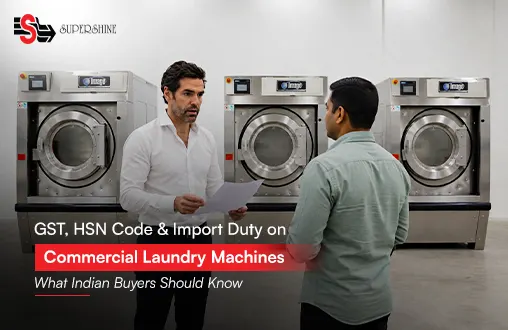
GST, HSN Code, and Import Duty on Commercial Laundry Machines: What Indian Buyers Should Know in 2026

Here’s a scene we’ve seen more than once. A hospital finalises its machine shortlist, the technical team signs off, and then the file lands with the finance department. Two weeks later someone asks, “Which HSN is this under, and are we paying the right GST?” Nobody has a clean answer. The purchase of commercial laundry equipment stalls, not over the machine, but over the paperwork. So let’s go through the tax side properly, the way an engineer who has sat through a few of these procurement meetings would explain it.
One caveat first. Tax notifications change, and your CA has the final word. What follows is the practical picture as of late 2026, with the points where you should double-check flagged clearly.
How Commercial Laundry Equipment Gets Classified: Machine First, Code Second
HSN classification isn’t about where a machine is installed. It’s about what the machine is and what it does. That’s why a front-loading washer in a hotel basement and one in a flat can share a heading, while a flatwork ironer sits somewhere else entirely.
In broad terms, two headings do most of the work for commercial laundry equipment in India:
- HSN 8450: household or laundry-type washing machines, including machines that wash and dry. Most commercial washing machine models, from a 10 kg front loader to a large washer-extractor, are generally treated here.
- HSN 8451: machinery other than 8450 types for washing, cleaning, wringing, drying, ironing, pressing, bleaching, dyeing or finishing yarns, fabrics and made-up articles. Think tumble dryers, flatwork ironers, finishing presses, dry-cleaning machines, hydro-extractors.
Parts and accessories carry their own sub-headings, and this is where invoices get sloppy. A vendor writing “8450” on a quote that includes a steam ironer is a red flag. Ask for the 8-digit code per line item. It costs nothing to ask.
What the GST Rate Looks Like Now
Since the GST rate restructuring that took effect on 22 September 2025, washing machines under 8450 are reported at 18%. Older rates varied by category, so ignore what an old quotation says and go by the current schedule. Eighteen percent is what you should expect to see on a quotation today.
For an intra-state sale, that’s 9% CGST plus 9% SGST. Across states, it’s 18% IGST. Machines under 8451 are commonly invoiced at the same 18% machinery rate, but sub-heading level exceptions do exist, and parts can differ. Have your tax consultant confirm the exact rate against the CBIC schedule for the model you’re buying, not for the category.
Two small practical points that save trouble later:
- Since the GSTR-1 HSN reporting changes in 2025, the digit-level requirement depends on your turnover. A wrong or truncated code on the supplier’s invoice can mismatch your records.
- Input tax credit generally works for business purchases, provided the supplier is registered, the invoice is valid and the code is right. Hotels and hospitals sometimes have restrictions depending on the nature of their taxable output, so don’t assume.
Buying Imported Commercial Laundry Equipment: The Duty Stack
Plenty of Indian buyers still look abroad for specific tunnel washer configurations, high-spin extractors or specialised finishing lines. If that’s you, GST is only one layer.
Customs works roughly like this. Basic Customs Duty is applied on the assessable value (CIF, basically cost plus freight plus insurance). Depending on the sub-heading and the year’s tariff changes, certain levies sit on top. Then IGST at 18% is charged on the value including the duties. That last bit surprises people: you’re paying tax on tax.
The BCD figure itself is where buyers should be careful. Published rates range from about 7.5% for some finishing-machine sub-headings to 20% for some 8450 entries, and the Budget 2026 exercise moved many rates from exemption notifications into the First Schedule without changing the effective duty. So it varies by sub-heading, and the live figure should come from your customs broker before you commit to a landed-cost number.
And then there’s everything around the duty. Freight, port charges, insurance, the customs broker, inland transport, and sometimes a longer wait for commissioning engineers. A machine that looked 15% cheaper on the overseas quote can come out level, or worse, once you’ve added it all.
Local Manufacturing vs Imports: A Straight Comparison
We’re not going to pretend imports have no place in the commercial laundry equipment market. For certain high-capacity tunnel systems, or a niche finishing process, the best machine may be built overseas. Global names like Milnor, Image Laundry Systems and Italclean are respected for good reason, and Supershine Laundry works with these lines as part of its range, so the import-versus-local question comes up in its consultations regularly.
Many laundry equipment manufacturers in India also assemble locally, which changes the duty picture. But for most hotels, hospitals, institutions and garment units, the sensible comparison is between three routes:
| Route | Tax and duty exposure | Typical practical trade-off
|
|---|---|---|
| Domestically manufactured | GST only | Faster parts, local service, less currency risk |
| Imported via an Indian distributor | GST, with duty already built into the price | Brand choice, but check parts stocking |
| Direct import by the buyer | Customs duty plus IGST, plus clearance work | You carry the logistics and compliance burden |
When you’re short-listing laundry equipment suppliers, ask which of these routes the quote represents. A distributor who has already cleared the goods hands you a GST invoice and takes the customs risk. A direct import makes you the importer of record, with all the paperwork that implies.
What to Ask Before You Sign for Commercial Laundry Equipment
Whether you speak to laundry equipment manufacturers directly or go through a dealer (or one of the other laundry equipment suppliers on your list), a decent quotation should answer these without a fight:
- The HSN code for each machine and each major accessory.
- GST rate and the split (CGST/SGST or IGST).
- Whether freight, installation and commissioning are inside the price, and what GST applies to that service portion (services are classified separately).
- For imported units, who is the importer of record and who handles customs clearance.
- Warranty terms, and where spares are physically stocked in India.
That last one isn’t tax, but it affects the true cost more than people admit. A part stuck at a port for three weeks costs you more in lost processing days than the duty ever did.
How This Plays Out in a Real Purchase
Supershine Laundry has handled this paperwork across 1,500+ installations in 35 years, across hotels, hospitals, defence and paramilitary units, garment factories and railways. Defence and government buyers tend to be the most particular about classification and invoicing format, which has taught the team to put the HSN and tax split on the quotation upfront rather than leaving it for the finance team to chase.
Supershine Laundry’s turnkey model helps here too. When consultation, capacity planning, machine selection, installation, commissioning and training sit with one party, the commercial breakup is easier to read: equipment lines carrying their own HSN, services shown separately. And the AMC and spare parts arrangement is priced as a clear item rather than buried inside a bundle.